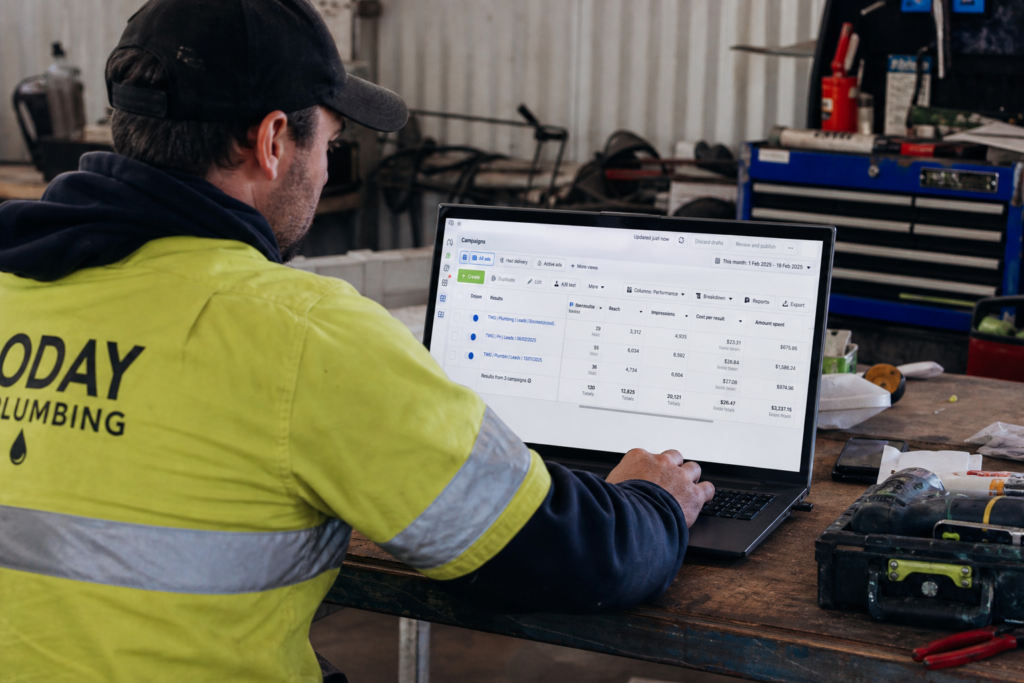
Facebook Ads for Tradies – What Works, What Doesn’t, and What to Spend
You’re scrolling through your Facebook feed on a Sunday arvo and you see an ad from a local sparky offering a free switchboard inspection. You tap it. You fill out the form. You forget about it by Monday.
That’s exactly what happens to your leads when you run Facebook ads without a system behind them.
We’ve managed Meta Ads (that’s what Facebook and Instagram ads are actually called now) for trade businesses across Australia for years. Some of those campaigns have produced thousands of leads. Others have been shut down inside a fortnight because the business wasn’t ready. We’ll explain in detail below.
This post is the honest version. What works. What doesn’t. What to spend. And why running Facebook ads without the right backend is like pouring water into a bucket full of holes.
Facebook Ads vs Google Ads for Tradies – They Do Different Jobs
Before we get into the detail, you need to understand the difference between Facebook ads and Google ads. They’re not the same thing, and they don’t do the same job.
Google Ads target people who are actively searching for a service right now. “Emergency plumber Sydney” or “solar panel installer Brisbane” – these are people with intent. They have a problem, and they want someone to fix it.
Facebook Ads interrupt people who aren’t looking for you. They’re scrolling through photos of their mate’s holiday, and your ad pops up offering a bathroom renovation. That person might need a bathroom renovation – but they weren’t looking for one at that exact moment.
This distinction matters because it changes everything about how you sell to those leads.
Google leads tend to be warmer. They’ve already decided they need help. Facebook leads are cooler. They’ve expressed interest, but they haven’t committed to anything yet. Which means your follow-up process, your speed to lead, and your sales approach all need to be different.
If you want the full breakdown on Google Ads, we’ve covered that here.
Who Should Be Running Facebook Ads?
Not every trade business should be running Facebook ads. That’s the truth most agencies won’t tell you because they want your monthly retainer.
Facebook ads work best when:
- You sell a considered purchase. Bathrooms, kitchens, solar panels, new builds, renovations – anything where the homeowner is going to think about it for a few weeks before committing. Facebook plants the seed early.
- You have a strong visual portfolio. Before-and-after photos, project walkthroughs, video testimonials – this content performs on social. If you’ve got nothing to show, your ads will struggle.
- You have capacity to follow up fast. Facebook leads go cold within hours, not days. If you’re calling back three days later, you’ve already lost them. We wrote about speed to lead and why it matters.
- You have a proper CRM to manage the leads. This is non-negotiable. Leads coming in via Facebook need to be tracked, followed up, and nurtured. A notebook on the dash of your ute doesn’t cut it.
Facebook ads probably aren’t right for you if:
- You only do emergency or reactive work (burst pipes, power outages). Those people search Google when the problem hits.
- You don’t have any visual content to use in the ads.
- You don’t have a system for following up leads within 5 minutes.
- You’re already maxed out on jobs and can’t take on more work.
What Actually Works on Facebook for Tradies
After running campaigns across plumbing, electrical, solar, roofing, building, landscaping, and pool businesses, here’s what consistently performs.
1. Lead Form Ads (Not Traffic Ads)
The biggest mistake tradies make is boosting posts or running traffic campaigns that send people to their website. Most tradie websites aren’t built to convert cold traffic. The visitor lands, looks around, and leaves.
Lead form ads keep the person inside Facebook. They tap the ad, a pre-filled form pops up (Facebook auto-fills their name, email, and phone from their profile), and they submit. Done.
The conversion rate on lead forms is significantly higher than sending traffic to a website. The trade-off is that lead quality can be lower because it’s so easy to submit. That’s where your follow-up system earns its keep.
2. Before-and-After Creative
This is the single highest-performing ad format for trade businesses. Side-by-side photos showing the transformation. A wrecked bathroom turned into something from a magazine. A patchy, dead lawn turned into a bowling green.
People stop scrolling for transformations. It’s visual proof that you do good work. No amount of clever copywriting beats a photo that speaks for itself.
3. Video Testimonials From Real Customers
A 30-second clip of a homeowner standing in their new kitchen saying “these guys were brilliant, turned up on time, cleaned up after themselves” outperforms any graphic your designer can produce.
It doesn’t need to be polished. In fact, the rougher it is, the more authentic it feels. Shoot it on a phone. Natural lighting. Real words. Done.
4. The “Free Inspection” or “Free Quote” Offer
Offering something free lowers the barrier. A free switchboard inspection. A free solar assessment. A free measure-and-quote for a deck.
The key is to make sure the free offer isn’t so generic that it attracts tyre-kickers. “Free quote” on its own pulls everyone. “Free 15-minute on-site solar assessment for homes in the Sutherland Shire” pulls qualified leads.
5. Retargeting Campaigns
Someone visits your website but doesn’t enquire. A few days later, they see your ad on Facebook showing a recent project you completed. This time they click and fill out the form.
Retargeting works because it catches people who were already interested but didn’t take action. The ad cost is lower, and the conversion rate is higher. It’s the closest Facebook gets to Google’s intent-based targeting.
What Doesn’t Work (and Will Waste Your Money)
Boosted Posts
Boosting a post from your business page is the easiest way to waste money on Facebook. It gives you reach (people see your post), but very little control over who sees it, what action they take, or how you measure results. It’s a vanity metric generator.
If you want to run ads, run them properly through Ads Manager with defined objectives, audiences, and tracking.
Image-Only Ads With No Clear Offer
A photo of your van with your logo and phone number is not an ad. It’s a business card nobody asked for. Every ad needs a clear offer and a clear next step. What are you offering? What should they do?
Targeting Everyone Within 50km
Facebook’s targeting is powerful, but only if you use it properly. Targeting “all males 25-65 within 50km of Sydney” is not a strategy. Narrow your audience by suburb, age, homeownership status, interests, and behaviours. The tighter the audience, the more relevant the ad, and the lower the cost per lead.
Running Ads Without a Follow-Up System
This is the big one. And it’s the reason we won’t run Facebook ads for any business that doesn’t have a CRM and lead management system deployed.
Facebook leads are not the same as referral leads. When your mate’s mate calls you because they heard you do good work, they’re already warm. They trust you by association.
A Facebook lead doesn’t know you. They tapped a button on their phone between watching a cooking video and checking the footy scores. If you don’t call them back within 5 minutes, they won’t remember filling out the form. If you don’t have a system that automatically texts them, emails them, and tracks where they are in the pipeline – you’re burning money.
We’ve written extensively about why owning your marketing system matters and what happens when you don’t.
How Much Do Facebook Ads Cost for a Tradie?
This is the question everyone asks, and the answer is: it depends. But here are some real ranges based on Australian trade businesses.
Ad Spend
- Minimum viable budget: $30-50 per day ($900-1,500/month). Below this, Facebook doesn’t have enough data to optimise your campaigns properly.
- Sweet spot for most tradies: $50-100 per day ($1,500-3,000/month). Enough to generate consistent leads across one or two service areas.
- Scaling budget: $100-250+ per day ($3,000-7,500/month). For businesses with the capacity and systems to handle higher lead volume.
Cost Per Lead
- Bathroom/kitchen renovations: $15-50 per lead
- Solar installations: $20-60 per lead
- Roofing: $25-70 per lead
- General plumbing/electrical (non-emergency): $15-40 per lead
- Landscaping/pools: $20-50 per lead
These numbers swing based on your location, creative quality, offer, and competition. A sparky in rural NSW will pay less per lead than a bathroom renovator in inner-city Melbourne.
Management Fees
If you’re working with an agency (like us), expect a management fee on top of your ad spend. This covers strategy, creative, campaign management, optimisation, and reporting. The fee varies, but what matters more than the fee is whether the agency is accountable for results – not just activity.
The Real Number That Matters – Cost Per Closed Job
A lead that costs $30 means nothing if it doesn’t turn into a job. What matters is what it costs you to win a paying customer.
If you spend $3,000 on ads and get 100 leads, that’s $30 per lead. If you close 10 of those at an average job value of $5,000, that’s $50,000 in revenue from $3,000 in ad spend. Your cost per acquisition is $300 for a $5,000 job.
That’s the number worth tracking. Not impressions. Not clicks. Not even leads. Closed revenue.
If you want to understand how to calculate this properly, we’ve got a marketing ROI guide that breaks the maths down.
The Facebook Ads Funnel for Trade Businesses
Here’s the structure that works for most trade businesses running Facebook ads:
Stage 1 – Awareness (Top of Funnel)
Video content or before-and-after carousels shown to a broad local audience. The goal isn’t leads – it’s getting your name and work in front of people in your area.
Stage 2 – Lead Generation (Middle of Funnel)
Lead form ads with a specific offer targeting homeowners in your service area. This is where the bulk of your budget sits.
Stage 3 – Retargeting (Bottom of Funnel)
Ads shown to people who visited your website, watched your videos, or engaged with your page but didn’t enquire. These ads push for the conversion with social proof (reviews, testimonials, case studies).
Stage 4 – Nurture (Post-Lead)
This isn’t technically Facebook ads anymore – this is your CRM taking over. Automated texts, emails, and follow-ups that keep you in front of leads who didn’t convert immediately.
The businesses that combine all four stages consistently outperform the ones that just throw money at lead generation without the rest of the system.
The Non-Negotiable – Your Lead Management System
We’ve said it multiple times in this post, and we’ll say it again. We won’t run paid ads for any business that doesn’t have a lead management system in place. Period.
It doesn’t matter how good your ads are if the leads die in the inbox.
We’ve seen it happen too many times. A plumbing business spends $3,000 on ads, generates 80 leads, and closes two jobs. They blame the ads. When we audit the pipeline, we find 40 leads that were never called back. 15 that were called once and never followed up. And 10 that were contacted three days after the form was submitted.
The ads worked. The follow-up didn’t.
If you’re serious about running Facebook ads, start with the system. Get a CRM built for tradies that handles automated follow-ups, lead tracking, and pipeline management. Then layer the ads on top.
This is exactly what Matt talks about when he says you don’t have a marketing problem – you have a structure problem.
Facebook Ads vs Doing Your Own Social Media
There’s a difference between running paid Facebook ads and posting on your business page organically.
Organic posting (sharing project photos, updates, and tips on your page) is free and valuable for building credibility. But the reach is tiny. Facebook shows your page posts to roughly 2-5% of your followers. If you have 500 followers, maybe 25 people see your post.
Paid ads put your message in front of thousands of targeted people who don’t follow you. That’s the difference between talking to your existing network and reaching new customers who’ve never heard of you.
Both have a place. But if you’re relying only on organic posts to generate new leads, you’re going to be waiting a long time.
How to Pick the Right Agency for Facebook Ads
If you decide to outsource your Meta Ads management, here’s what to look for:
- They understand trades. An agency that manages ads for cafes, yoga studios, and electricians doesn’t understand the difference between a referral lead and a cold lead in the trades. Industry experience matters.
- They talk about systems, not just leads. If the pitch is “we’ll get you 50 leads a month” with no mention of how those leads get followed up, walk away. Leads without a system are just names on a list.
- They’re transparent about results. You should know exactly how much you’re spending, how many leads you’re getting, what those leads are costing, and how many are converting to jobs. If the reporting is vague, the results probably are too.
- They won’t run ads until you’re ready. Any agency worth working with will assess your follow-up process, your CRM, and your capacity before launching campaigns. If they’re happy to take your money and start running ads tomorrow without checking any of that – they’re not managing your results, they’re managing their revenue.
We’ve written a detailed guide on how to choose a marketing agency for your trade business if you want the full checklist.
Should You Run Facebook Ads or Google Ads First?
If you can only afford one, start with Google Ads. Google targets people who are already searching for your service. The leads are warmer. The close rate is higher. The sales process is simpler.
Once Google is profitable and your lead management system is running smoothly, add Facebook into the mix. Facebook expands your reach, builds brand awareness, and fills the top of your pipeline with leads that Google would never have captured.
The best-performing trade businesses we work with run both. Google catches the people searching now. Facebook catches the people who’ll need you in the next 3-6 months.
For a deeper dive, check out our post on digital marketing for tradies and what actually works.
Common Questions About Facebook Ads for Tradies
How long before Facebook ads start working?
Give it 2-4 weeks. Facebook’s algorithm needs time to learn who responds to your ads. The first week or two is a learning phase where costs may be higher and results inconsistent. By week three, the system starts optimising and cost per lead stabilises.
Can I run Facebook ads myself?
You can. Facebook Ads Manager is free to use. But doing it well requires understanding audience targeting, creative strategy, conversion tracking, A/B testing, and budget optimisation. Most tradies we talk to try it themselves first, spend $500-1,000 with nothing to show for it, and then come to us. If you’ve got the time and patience to learn, go for it. If you’d rather spend that time quoting jobs and doing installs, outsource it.
Do I need a Facebook page with lots of followers?
No. Your follower count has almost no impact on ad performance. Ads are shown to people based on targeting, not your existing audience. That said, when someone sees your ad and checks your page, it helps if the page looks active with recent posts, reviews, and project photos.
What about Instagram ads?
When you run ads through Meta Ads Manager, you can choose to show them on Facebook, Instagram, or both. Instagram tends to work well for visually driven trades (renovation, landscaping, pools) and for reaching a slightly younger demographic. The ad creation and management is done in the same place.
How do I know if my ads are actually working?
Track three numbers. Cost per lead (how much each enquiry costs). Lead-to-quote rate (how many leads turn into quotes). Quote-to-close rate (how many quotes turn into jobs). If you can track those three numbers, you can work out exactly what each closed job costs you in ad spend – and decide if it’s worth it.
Will Facebook ads work in a small town?
Potentially, but the audience size may be too small for Facebook to optimise effectively. If your total addressable market is under 10,000 people, you might burn through the audience quickly. In these cases, Google Ads and SEO are usually more effective because they capture the demand that already exists rather than trying to create it.
What happens to my leads if I stop running ads?
They stop coming. Paid ads are a tap – when you turn it off, the water stops. That’s why it’s important to build organic channels (SEO, content, Google Business Profile) alongside your paid campaigns. We’ve covered the full SEO strategy for tradies if you want to start building that foundation.
Should I use special offers in my ads?
Offers work when they’re genuine and specific. “10% off all bathroom renovations booked this month” gives people a reason to act now. Generic “call us for a free quote” doesn’t – because every other tradie is saying the same thing. Make the offer specific, time-limited, and valuable.
What to Do Next
If you’re thinking about Facebook ads for your trade business, here’s the honest sequence:
- Fix your follow-up system first. Get a CRM that tracks leads, sends automatic responses, and gives you a pipeline to manage. Without this, ads are a waste of money.
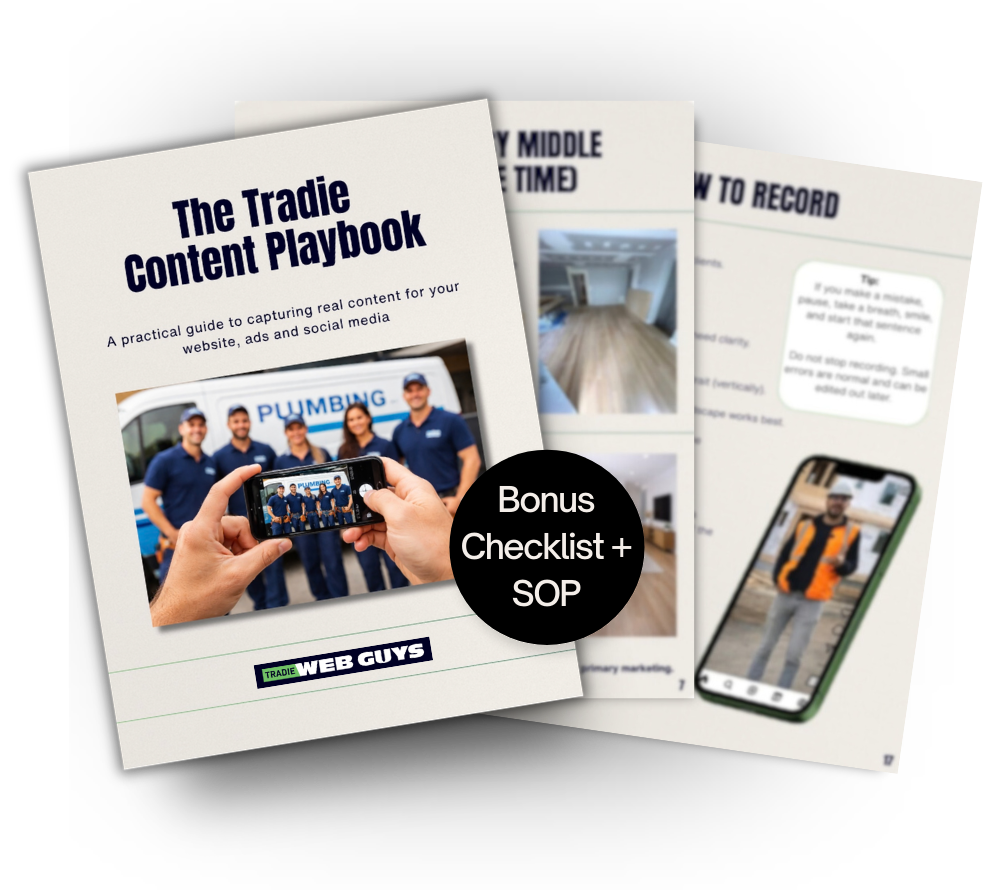
- Build your content bank. Collect before-and-after photos, get video testimonials from happy customers, and start documenting your work. This is your ad creative.
- Get your numbers straight. Know your average job value, your close rate, and what you can afford to pay per lead. This determines your budget and your targets.
- Then run ads. With the system, the content, and the numbers in place – now you’re ready to turn the tap on.
If you want help mapping this out for your specific business, book an Impact Roadmap Session. It’s a paid working session where we assess your business, identify the gaps, and build a strategy – not a sales pitch. And if you decide to work with us, we credit it back, so essentially it costs you zilch.