SEO gets trade businesses found by homeowners who are already searching for what they do — that’s the whole point. Done right, it puts you in front of the right people, in the right area, at exactly the right moment — and unlike paid ads, the results compound over time.
But here’s where most tradies get stuck. They hear “SEO” and either dismiss it entirely (“I’ve tried that, didn’t work”) or they hand over money to some overseas agency who sends a monthly PDF of rankings nobody cares about. Neither approach gets you more jobs.
This guide covers what actually works in 2026 — local SEO, Google Business Profile, on-page content, technical foundations, location pages, reviews, and the relationship between SEO and Google Ads. It’s not theoretical. It’s what we’ve applied across hundreds of trade businesses across Australia.
What Is SEO and Why Do Tradies Need It?
SEO — search engine optimisation — is the process of making sure your business shows up when someone searches for what you do in your area. “Emergency electrician Parramatta.” “Roof replacement Sydney.” “Best plumber Moreton Bay.” Those searches happen every single day, and someone is winning that business. The question is whether it’s you or your competitor.
Most trade businesses have relied on referrals and word of mouth for years. And that’s worked — until it hasn’t. The problem with word of mouth is simple: you can’t predict it, you can’t scale it, and you don’t own it. When referrals slow down, there’s nothing to turn up. No system. No pipeline. Just silence.
SEO is the opposite of that. It’s a system you build and own — one that generates leads consistently, without you paying per click every time a homeowner searches.
SEO isn’t a light switch. You don’t turn it on and get leads tomorrow. The honest timeline is 3–6 months to start seeing meaningful movement, and 6–12 months to see serious results. Anyone telling you otherwise is selling something you should walk away from.
How Does Google Decide Who Ranks?
Google’s job is to show the most relevant, trustworthy result to the person searching. For local searches, that means Google is weighing three things:
Relevance — Does your website match what the person searched for? Does your Google Business Profile reflect the right services and location?
Proximity — How close are you to the person searching? This matters a lot for trades work, where “local” actually means something.
Authority — Has Google seen enough signals from other credible sources that it trusts your business? Reviews, backlinks, citations, content — all of it contributes.
These three factors shape everything that follows. Every tactic in this guide is either building relevance, proving proximity, or establishing authority.
Local SEO: The Foundation for Every Trade Business
Local SEO is different from general SEO. You’re not competing with every plumber in Australia — you’re competing with every plumber in your service area. That narrows the field significantly and makes winning very achievable.
The local SEO system for tradies has four main components:
1. Google Business Profile
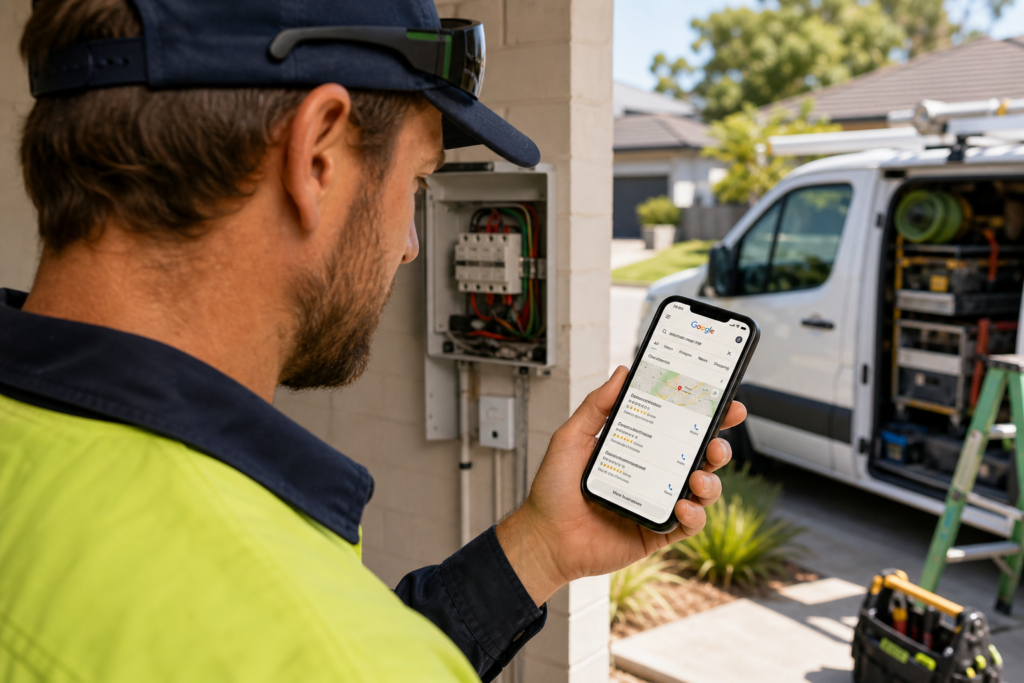
If there’s one thing that moves the needle faster than anything else for local trade businesses, it’s Google Business Profile (GBP). When someone searches “plumber near me” or “electrician Cronulla,” Google shows a map pack — three local businesses with their ratings, address, and a call button. That map pack is prime real estate.
To rank well in the map pack:
- Complete every section of your profile. Business name, category, address, phone, website, hours, services, photos, description — all of it. Incomplete profiles rank poorly.
- Choose the right primary category. “Electrician” not “contractor.” “Plumber” not “home services.” Be specific.
- Add services with descriptions. Don’t just say “Plumbing” — add Blocked Drains, Hot Water Repairs, Pipe Replacement as individual services with real descriptions.
- Upload real photos regularly. Job site photos, team photos, before-and-afters. Not stock images — Google can tell, and homeowners definitely can.
- Use Google Posts. Think of them like social posts inside Google. Short updates, promotions, recent projects. They signal to Google that your profile is active.
- Turn on Google Messaging. Homeowners can message you directly from your profile. Fast response wins.
For more depth on GBP optimisation and what moves rankings in the map pack, read our guide on Google Maps Ranking for Tradies.
2. Google Reviews
Reviews aren’t just social proof — they’re a ranking signal. The number of reviews, the recency, and the quality of those reviews all influence where you appear in local search.
A roofing business we work with in Queensland went from Page 2 to consistently top-3 in the map pack within four months. One of the biggest moves was a systematic review strategy — they went from 11 reviews to 64. Every completed job triggered a follow-up SMS asking for a review. Simple system. Big result.
The specifics:
– Ask at the right moment. Right after a job is complete — when the homeowner is happiest — is when to ask. Not three weeks later.
– Make it easy. Send them the direct link. Don’t make them search.
– Respond to every review. Google rewards businesses that engage. And homeowners read your responses — it tells them a lot about how you run your business.
– Never, ever buy fake reviews. Google will find them and penalise your profile. It’s not worth it.
See also: Google Reviews for Local Business
3. Local Citations
Citations are mentions of your business name, address, and phone number (NAP) across the web — directories like Yellow Pages, True Local, Yelp, Hotfrog, and industry-specific sites. They’re not a massive ranking factor on their own, but consistency matters.
If your business is listed as “ABC Plumbing” on your website, “ABC Plumbing Services” on Yellow Pages, and “ABC Plumbing & Gas” on Yelp — that inconsistency confuses Google. Clean it up. Make every citation match exactly.
On-Page SEO: Making Your Website Do the Work
Your Google Business Profile handles the map pack. Your website handles organic rankings — the blue links below the map. Getting both working together is how you dominate local search.
The Basics That Most Tradie Websites Get Wrong
Title tags. These are the clickable blue links in search results. Every page on your site needs a unique title tag that includes your primary keyword and location. “Plumber Sydney | Hot Water, Blocked Drains & Gas Fitting” — specific, local, tells Google and the homeowner exactly what the page covers.
Meta descriptions. The short description under the title in search results. Doesn’t directly affect rankings, but affects click-through rate. A compelling meta description gets more clicks. More clicks over time signals to Google that your result is relevant. It compounds.
H1 tags. Every page has one H1 — the main heading. It should include your primary keyword. “Blocked Drain Plumber in Parramatta” — not “Our Plumbing Services.”
Content that actually says something. Thin pages with 150 words of generic fluff don’t rank. Google needs content it can read and understand. For a service page, that means explaining what you do, how you do it, who you do it for, and where you work. Real information.
The Pages Your Site Needs
Service pages. One page per service — not one page for all services. A separate page for Blocked Drains, Hot Water Repairs, Gas Fitting, Leak Detection. Each with its own title tag, content, and call to action. This is how you rank for specific terms.
Location pages. If you work across multiple suburbs or cities, each location needs its own page. This is one of the most underused tactics in trade SEO. More on this below.
About page. Tradies skip this. Don’t. Homeowners want to know who they’re inviting into their house. A real about page — with your story, your team, your service area, actual photos — builds trust and supports rankings.
Location Pages: How to Dominate Multiple Areas
If you service ten suburbs but have one page that says “we service the greater Sydney area,” you’re not ranking for any of those suburbs. Google can’t connect your business to a location unless you tell it explicitly — and “we service Greater Sydney” isn’t explicit.
Location pages solve this. A location page is a dedicated page for each suburb or city you work in. “Plumber in Parramatta.” “Plumber in Penrith.” “Plumber in Blacktown.” Each one signals to Google that you serve that specific area, with specific keywords, specific content, and specific proof.
But here’s where most people stuff this up: they create location pages that are copy-paste duplicates with the suburb name swapped out. Google hates that. We’ve seen sites penalised for exactly this.
Each location page needs:
– Unique content that references the actual area (local landmarks, common issues in that suburb, real project mentions if possible)
– Embedded Google Map
– Local phone number if you have one
– Relevant service details for that area
– Internal links back to your service pages
Done right, location pages can multiply your search presence dramatically. We’ve had trade businesses go from ranking in one suburb to ranking across twenty within six months of building a proper location page strategy.
Full breakdown on this: How Tradies Can Use Location Pages to Dominate Local Search
Keyword Research: Stop Guessing What to Target
Most tradies do one of two things with keywords: they either target the most competitive terms (“plumber Sydney” — which is brutal to rank for) or they target nothing at all and hope Google figures it out.
Neither works.
Keyword research is about finding the specific terms your ideal customers are actually typing into Google. Not what you think they search. What they actually search.
For trade businesses, those terms tend to be:
– Service + location: “emergency plumber Campbelltown”
– Problem + location: “burst pipe repair North Shore”
– Question-based: “how much does a hot water system cost in Brisbane”
– Near me: “electrician near me” (dominated by your GBP if optimised correctly)
The sweet spot is moderate search volume + lower competition. Going after “plumber” nationally is a losing battle. Going after “gas plumber Toowoomba” or “bathroom renovation plumber Brisbane southside” is very winnable.
For more on this: Why Your Keyword Research Isn’t Bringing You More Work
Technical SEO: The Stuff That Has to Work Correctly
Technical SEO isn’t glamorous but it matters. If your site has technical issues, Google can’t crawl it properly and your content doesn’t rank regardless of how good it is.
Site Speed
Google has been explicit about this for years: slow sites rank lower. For trade businesses where most traffic is mobile, a page that takes 4–5 seconds to load is losing enquiries before anyone even reads it. Your site needs to load in under 3 seconds — ideally under 2.
Common culprits: oversized images, cheap hosting, outdated plugins, excessive scripts, no caching.
Mobile Responsiveness
More than 70% of searches for trade services happen on mobile. If your site isn’t built for mobile — not just “works on mobile” but actually designed for it — you’re behind. Buttons that are too small, text that requires zooming, forms that are frustrating to fill out. All of it kills conversions.
Read: Essential Mobile Website Design Tips Every Tradie Needs
HTTPS / Security
If your site is still on HTTP, fix it today. Google doesn’t trust HTTP sites. Neither do homeowners — especially when they’re submitting a contact form.
Indexability
Google can only rank pages it can find and read. If pages are blocked from crawling, have no-index tags, or aren’t in your sitemap, they won’t rank. Worth a regular check, especially on WordPress sites after plugin updates.
Read: How Indexability Makes Your Trade Website Search-Ready
Avoiding Duplicate Content
Thin, repeated content across multiple pages hurts your rankings. This is a common issue on tradie sites with multiple location pages that are essentially copies of each other. Google sees duplicate content as low quality and deprioritises those pages.
Read: Why Duplicate Content Hurts Trade Business SEO & How to Fix It
Content Strategy: Building Authority That Compounds
The trade businesses that win at SEO long-term aren’t just the ones with good service pages. They’re the ones that have become the trusted advisor in their niche and area.
That means content.
Blog posts, FAQ pages, how-to guides, project case studies — all of it helps. Not because you’re going to go viral. Because over time, Google recognises your site as a legitimate authority on what you do, and the rankings follow.
The content you should be creating:
Common questions your customers ask. “How long does a hot water system installation take?” “What’s the difference between pipe relining and excavation?” “Do I need a permit for a bathroom renovation?” Every one of those is a search someone is making right now.
Local area content. “Common plumbing issues in older homes in [suburb].” “Why homes in [area] struggle with blocked drains.” Hyper-local content that nobody else is writing.
Project posts. Before-and-after content on real jobs. Homeowners love this, and it signals to Google that you’re actively doing the work.
You don’t have to write these yourself. That’s what a marketing team is for. But the knowledge has to come from you — real experience, real situations, real answers.
SEO and Google Ads: They Work Together, Not Against Each Other
A lot of tradies think they have to choose — either do SEO or run Google Ads. They’re not the same investment with the same return profile, and they’re not competing.
Google Ads gives you immediate visibility. The moment you launch a campaign and set a budget, you’re appearing at the top of search results. That’s valuable when you’re building a new business, entering a new market, or filling the calendar during slow periods.
SEO gives you compounding, owned visibility. Three years of well-executed SEO means you’re getting leads that cost you nothing per click. That’s visibility you own — not visibility you rent.
The trade businesses growing fastest in 2026 are running both. Google Ads fills the pipeline in the short term while SEO builds the long-term asset. Once SEO starts producing, ad spend can be redirected to more competitive terms or new markets.
The mistake is treating them as mutually exclusive. They’re not.
Generative Engine Optimisation (GEO): SEO in the AI Search Era
Here’s what’s changed in 2025–2026 that most tradies (and most agencies) aren’t factoring in: AI-powered search.
When someone asks Google’s AI Overview “who’s the best plumber in Brisbane?” or asks ChatGPT “can you recommend a reliable electrician in Melbourne?”, the answer doesn’t come from a ranked list of websites. It comes from AI that has synthesised information from across the web — your Google Business Profile, your reviews, your website content, your citations, third-party mentions.
This is Generative Engine Optimisation — the practice of making sure AI search tools can find, understand, and recommend your business.
The good news: most of what you do for traditional SEO also helps with GEO. A well-structured website, strong GBP, detailed service descriptions, positive reviews, and consistent citations all contribute to AI findability.
What helps specifically for GEO:
– Clear, factual content that directly answers common questions (structured Q&A format)
– Your business name, location, and specialties mentioned consistently across the web
– Schema markup — technical code that tells search engines exactly what your business does
– Positive sentiment in reviews (AI reads the content of reviews, not just the star rating)
– Being mentioned on reputable third-party sites
More on this: Generative Engine Optimisation (GEO) Explained
What a Realistic SEO Timeline Looks Like
Let’s be straight about this, because too many agencies oversell it.
Months 1–2: Technical setup, on-page optimisation, GBP overhaul. The foundation gets laid. You probably won’t see movement yet. This is normal.
Months 3–4: Early signs of movement. Some keywords start climbing. Map pack rankings improve in less competitive suburbs. GBP enquiries tick up. You’re seeing green shoots, not harvest.
Months 5–6: Meaningful rankings start appearing for your core service + location terms. Lead volume from organic search begins to climb. The investment starts paying itself back.
Months 7–12: Compounding returns. Rankings solidify. Location pages start ranking. Content starts generating traffic. The SEO system becomes a genuine lead source, not a supplement.
Month 13 and beyond: This is where the real ROI lives. Rankings you’ve built don’t evaporate when you stop paying a monthly ad invoice. They’re assets. The leads from this point have a dramatically lower cost per acquisition than paid ads.
Is this guaranteed? No. Timelines vary based on your competition, your starting point, the quality of execution, and how well you support the process (content, photos, responding to reviews). But this is the realistic arc for a trade business that’s serious about it.
How UX Affects SEO Rankings
Google doesn’t just look at what’s on your website — it pays attention to what people do when they land there. If someone clicks your result, lands on your site, and immediately hits the back button, that’s a signal to Google that your site didn’t deliver what they were looking for.
This is where UX (user experience) and SEO intersect. A site that’s slow, confusing, or hard to navigate loses the SEO value it earned just to get someone there.
What this means practically:
– Your phone number needs to be visible without scrolling on mobile
– Your contact form needs to be short and simple
– Your pages need a clear next step (call us, get a quote, book now)
– Your content needs to answer the question quickly — not bury it in fluff
Read more: How UX and SEO Work Together for Trade Websites
What to Look for in an SEO Agency for Tradies
If you’re considering hiring someone to manage your SEO, there are a few things that will tell you quickly whether you’re talking to someone worth working with.
They should be able to explain what they’re doing in plain English. If the strategy is “we post 50 backlinks a month and check rankings weekly” — that’s not a strategy. That’s a spreadsheet.
They should be focused on leads and jobs, not just rankings. A ranking is meaningless if it doesn’t produce enquiries. Ask them how they connect SEO activity to actual business outcomes.
They should have experience with trade businesses specifically. Local SEO for a plumber has different challenges than SEO for an e-commerce brand. Industry context matters.
They should show you real results from real clients. Not case studies with no client name, no industry, and no specifics. Real businesses. Real numbers.
And they should be building something you own. Your website, your GBP, your content — all of it should belong to you. The moment you stop paying, you should still have the asset. If an agency is building on platforms you don’t control or withholding your account access, walk away.
FAQs
How long does SEO take to work for tradies?
Realistic timeline is 3–6 months to start seeing meaningful rankings movement and lead growth. Significant results — where SEO becomes a primary lead source — typically hit the 6–12 month mark. This depends on your competition, your starting position, and the quality of the work being done. Anyone promising results in 30 days is selling you something to be wary of.
Is SEO worth it for a small trade business?
Yes — and arguably it’s more valuable for smaller trade businesses than large ones, because organic rankings cost the same to maintain whether you’re doing $500K or $5M in revenue. A well-optimised GBP and website can generate significant enquiry volume without a per-click cost. The investment has a compounding return that paid ads don’t.
What’s the difference between local SEO and regular SEO?
Local SEO is focused on ranking in your geographic service area — the Google map pack, suburb-specific search terms, GBP rankings. Regular (or national) SEO is about ranking for broader terms without location targeting. For trade businesses serving homeowners, local SEO is almost always the priority.
How many Google reviews do I need to rank well?
There’s no magic number. What matters is having more recent, high-quality reviews than your direct competitors. A consistent system to generate new reviews over time is more valuable than a one-off push to 50. Recency matters — ten reviews in the last month is better than 50 reviews from five years ago.
Do I need a blog for SEO?
Not necessarily, but it helps. Blog content builds topical authority, captures question-based searches, and gives Google more pages to rank. For a trade business, a targeted blog — even 2–4 posts a month — can meaningfully accelerate rankings over a 6–12 month period. It doesn’t need to be long. It needs to answer real questions your customers are asking.
Can SEO and Google Ads work together?
Absolutely. They’re not substitutes — they’re complementary. Google Ads gives you immediate, paid visibility. SEO builds compounding, owned visibility. Running both means you’re capturing demand at every stage, and as SEO matures, you can reallocate ad spend to more competitive terms where organic isn’t yet ranking.
Why is my SEO not working?
Common reasons: thin or duplicate content on service and location pages, incomplete or inconsistent Google Business Profile, very few or no reviews, poor mobile experience, slow site speed, or poor-quality backlinks from an older strategy. Sometimes it’s also just timeline — SEO takes months, and people often bail before the results arrive.
What is GEO and does it matter for tradies?
GEO — Generative Engine Optimisation — is the practice of making your business findable and recommendable by AI search tools like Google’s AI Overviews and ChatGPT. It matters because a growing portion of homeowners are using AI to find and evaluate service providers. The good news: solid traditional SEO — good content, strong GBP, consistent citations, real reviews — is the same foundation GEO is built on.
Ready to Build an SEO System That Actually Works?
Most trade businesses don’t have an SEO problem. They have a consistency and strategy problem — they’ve tried bits and pieces without a system behind it, wondered why nothing stuck, and written the whole thing off.
SEO works. It works for plumbers, electricians, builders, roofers, solar installers, and landscapers across Australia. We’ve seen it. We’ve built it for hundreds of them.
But it takes the right approach, the right foundation, and enough time to let it compound.
If you want help auditing your current setup and building a marketing system that belongs to you, book an Impact Roadmap Session. We will walk through every platform, every account, and every asset, then build a plan to put you in full control of your marketing infrastructure.