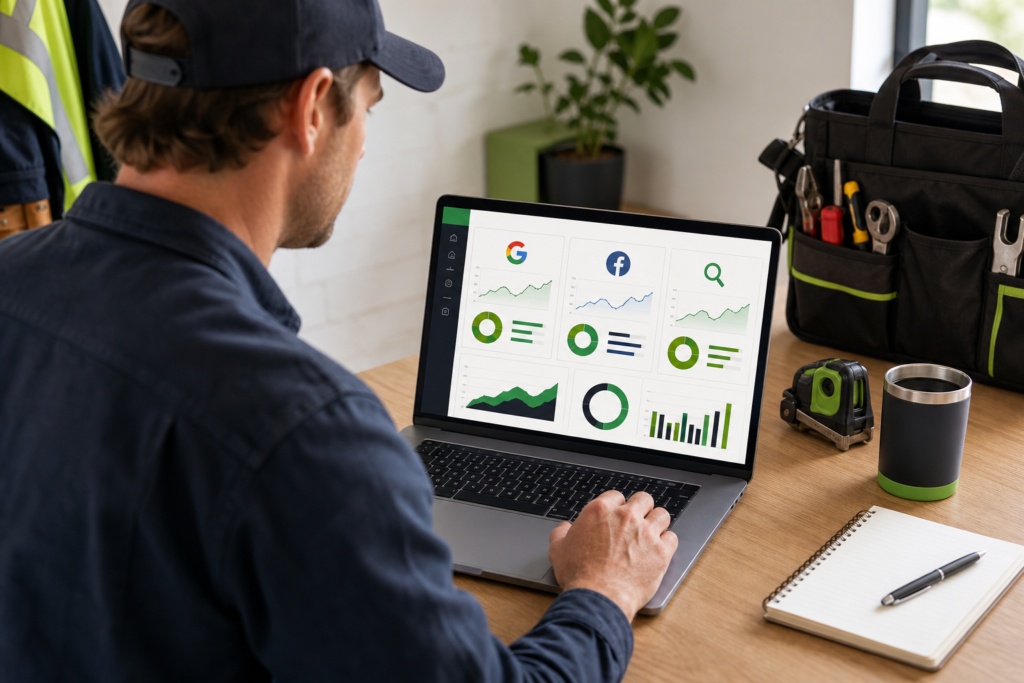
Digital marketing for trade businesses works when it’s built as a system, not a scattered collection of tactics. The tradies doing the most revenue right now aren’t the ones with the best ads or the fanciest website — they’re the ones with every piece connected and working together.
Most trade businesses aren’t there yet. They’ve tried a few things, got inconsistent results, maybe got burned by an agency, and now they’re not sure what to trust. This guide cuts through it — what channels are worth your time and money in 2026, what’s changed, and what you can safely ignore.
Why Most Tradies’ Digital Marketing Doesn’t Work
Before we get into what works, let’s be honest about why so much of it fails.
It’s not the platforms. Google Ads works. Facebook Ads work. SEO works. Every one of these channels is generating serious, quantifiable revenue for trade businesses right now. We see it every week.
The problem is almost never the channel. It’s the absence of a system.
A homeowner searches for a plumber, clicks your ad, fills in the form. Then what? The lead sits in an email inbox until someone gets around to it — maybe today, maybe tomorrow, maybe after the weekend. By then, they’ve already booked someone else. Not because your service is worse. Because you were slower.
That’s the gap. Most tradies don’t have a lead generation problem. They have a lead management problem. Marketing floods the bucket — but the bucket has holes in it. Speed of response, follow-up systems, quote process, CRM — these are what determine whether the marketing investment pays off.
Fix the holes first. Then turn up the tap.
What’s Changed in 2026
A few things have shifted significantly in the last 12–18 months that every trade business needs to understand.
AI Search Is Real Now
Google’s AI Overviews are showing up at the top of search results for an increasing range of queries. ChatGPT and other AI assistants are being used by homeowners to find and evaluate service providers. This isn’t coming — it’s here.
When someone asks an AI “who’s the best solar installer in Brisbane?”, the answer doesn’t come from a ranked list. It comes from the AI synthesising your website content, your reviews, your Google Business Profile, and third-party mentions. If those signals aren’t strong and consistent, you won’t get recommended.
This is what’s called Generative Engine Optimisation (GEO). It’s not a replacement for traditional SEO — it’s built on top of the same foundations. But it means the content on your website matters more than ever, and so does having a coherent, consistent presence across the web.
More on this: How to Rank in Google AI Mode as a Tradie
Speed to Lead Has Become a Competitive Weapon
The data on this is pretty unambiguous. Lead conversion rates drop dramatically after the first 5 minutes. Businesses that respond in under a minute convert at significantly higher rates than those that respond in 30 minutes. It sounds obvious. And yet the average trade business is still calling leads back the next morning.
AI tools for lead response have gone from experimental to practical. An AI-powered phone answering service that responds to missed calls in 30 seconds, qualifies the enquiry, and books a follow-up — that’s real now, and it’s running in trade businesses around Australia.
The Per-Lead Model Is Getting Worse
Services that sell shared leads — where the same enquiry goes to three, four, five businesses — are getting more expensive and less effective. Homeowners are catching on, and competition on those shared leads is brutal. The tradies building real marketing assets (their own website, their own SEO, their own ad accounts) are pulling ahead because they own their leads outright. No sharing. No bidding war. No landlord.
The Channels That Actually Work in 2026
Your Website: The Foundation of Everything
Everything in your digital marketing points to your website. Your Google Ads. Your Facebook Ads. Your SEO. Your Google Business Profile. Your social media. All of it.
If the website is broken, slow, confusing, or fails to convert — every dollar you spend on traffic is wasted. It’s the bucket with the holes. Fix the website first.
What “working” looks like for a tradie website in 2026:
- Loads in under 3 seconds on mobile (non-negotiable)
- Phone number visible without scrolling on every page
- Clear service pages — one page per service, not one page for all of them
- Real photos of your team, your jobs, your work
- Short, simple contact form (name, phone, message — that’s it)
- Social proof front and centre: reviews, project photos, client outcomes
- Fast response mechanism — live chat, AI chat, or a click-to-call button that routes immediately
A trade business website that converts well is worth more than a billboard in every suburb you service. It works around the clock. It never calls in sick. And unlike a Yellow Pages listing, it’s owned by you.
Read: Why Your Tradie Website Design Isn’t Getting You More Jobs
SEO: The Asset That Compounds
SEO — search engine optimisation — is the process of making your website and Google Business Profile appear when homeowners search for what you do in your area.
It’s not fast. It’s not flashy. It takes 3–6 months to start producing meaningful results, and 6–12 months to become a serious lead source. But here’s what makes it valuable: once you’ve built it, it doesn’t switch off when you stop paying. You own the rankings. You own the traffic. The cost per lead from organic search, over time, is dramatically lower than paid advertising.
The core of local SEO for trade businesses:
- Google Business Profile — optimised, active, reviewed regularly
- Service pages — one per service, with real content and local keywords
- Location pages — a dedicated page for each suburb or area you service
- Reviews — systematic, ongoing, with responses
- Technical foundations — fast site, mobile-first, no duplicate content, proper indexing
In 2026, SEO also means keeping an eye on AI search signals. Content that’s clear, structured, and genuinely helpful gets recommended by AI tools as well as ranked by Google. These aren’t separate strategies — they run in parallel.
Google Ads: Immediate, Controllable, and Expensive if Mismanaged
Google Ads puts your business at the top of search results immediately. Someone searches “emergency plumber Sydney” at 10pm on a Sunday night — with a properly managed Google Ads account, you’re there. No SEO timeline. No waiting for content to index. You’re visible right now.
This immediacy is why Google Ads is the fastest way for a trade business to generate leads from cold traffic.
But it’s also the fastest way to burn money if it’s not set up and managed correctly. The most common mistakes:
- Too-broad keyword targeting. You’re paying for searches that will never convert — wrong suburb, wrong service, wrong intent.
- Generic landing pages. Sending ad traffic to your home page instead of a dedicated landing page for the specific service and location.
- No negative keyword list. You’re paying for “plumber jobs near me” from people who want employment, not plumbing.
- Set-and-forget. Google Ads needs active management — bidding adjustments, search term mining, ad testing.
- Tracking that doesn’t work. If you can’t see which keywords and ads are generating actual phone calls and form fills, you’re flying blind.
A well-managed Google Ads account for a trade business typically runs at a cost-per-lead that makes strong commercial sense. A poorly managed one bleeds money.
Read: Google Ads Optimisation Checklist for Tradies
Facebook and Meta Ads: Interruption Marketing Done Right
Google Ads captures intent — people who are already searching for what you do. Facebook and Meta Ads are different. You’re showing up in someone’s feed while they’re scrolling, not searching. That’s interruption marketing.
For trade businesses, Meta Ads work well when:
- You have a specific offer or campaign — solar installation promotions, seasonal offers, bathroom renovation specials
- You want to build brand awareness in a specific area — so when homeowners eventually need your service, your name is already familiar
- You’re retargeting people who visited your website — someone who checked your roofing page last week sees your ad this week. That’s warm traffic.
Where Meta Ads struggle for tradies: emergency services. If someone’s hot water just died, they’re Googling a plumber — not scrolling Facebook. For high-intent, immediate-need searches, Google Ads is the better investment. For planned projects and brand building, Meta complements it well.
CRM and Automation: Where the Money Actually Gets Made
Truthfully, this is the most underrated part of the whole system.
A CRM — Customer Relationship Management system — is the tool that manages your leads, your quotes, your follow-ups, your booked jobs, and your customer communication. Without one, every lead that comes in becomes an administrative event that depends entirely on whoever happens to be available to deal with it.
The problem: most tradies don’t have one. Or they have something cobbled together — a spreadsheet, a WhatsApp thread, a follow-up system that exists only in someone’s head.
What a proper CRM does for a trade business:
- Captures every lead from every channel — Google Ads, Facebook Ads, website forms, phone calls — in one place
- Triggers immediate follow-up — auto-SMS to the lead within seconds of enquiry, so response time is instant
- Manages the quote pipeline — you can see exactly where every lead is in the process at any point
- Automates follow-up sequences — if a lead doesn’t book after the first contact, they get a follow-up at 24 hours, at 72 hours, at a week
- Tracks every job and customer for reactivation campaigns and referral asks
The difference between a business with a CRM and one without isn’t leads. It’s jobs. Same number of leads, significantly more closed.
We built Tradie Hub specifically for this — a CRM system designed for trade businesses, with workflows built around how trades actually operate. Not a generic CRM that was designed for insurance salespeople and has been bolted onto a trades context.
Read: Sales Automation for Tradies: From Missed Calls to Booked Jobs
AI Tools: Where to Use Them (and Where Not to)
AI has gone from buzzword to genuinely useful in the last two years. For trade businesses, the practical applications that are worth paying attention to:
AI phone answering. A missed call is a lost lead. An AI that answers at 11pm, qualifies the enquiry, books a callback or appointment, and sends the homeowner a confirmation — that’s a real thing. It’s not perfect. But it recovers leads that would otherwise disappear.
AI content and copy. Blog posts, service page content, email sequences, social posts. AI can produce first drafts that are 70–80% of the way there, which a team member can edit and publish. It doesn’t replace human judgment — but it accelerates output dramatically.
AI in CRM workflows. Automated follow-up sequences, lead qualification chatbots, review request triggers. These are table-stakes in a well-built CRM setup now.
What AI isn’t ready to do: replace your sales process. AI can answer basic questions and qualify intent. It can’t close a $40,000 renovation job. The humans in your business still need to do the actual selling, especially on high-ticket projects.
Read: AI Content Writing Strategies Every Tradie Should Know
Content Marketing: The Long Game That Most Tradies Ignore
Here’s the thing about content: most tradies won’t do it. Not because it doesn’t work — it does. Because they don’t like being on camera, they feel awkward writing, and there’s always something more urgent to deal with.
That reluctance is an opportunity. The fact that your competitors aren’t doing it means the field is relatively clear.
What content does for a trade business:
- Builds authority and trust — homeowners who’ve watched two of your videos or read three of your blog posts before calling have already pre-qualified you. The sales conversation is much easier.
- Supports SEO — content is what Google reads to decide if your site is worth ranking. More useful, relevant content means more pages ranking for more terms.
- Feeds social media and email — one piece of content can be cut into social clips, email content, and website posts. It multiplies.
- Positions you above the competition — the tradie who shows homeowners how to spot a dodgy electrical quote, or explains the difference between pipe relining and replacement, is the obvious choice when the job comes up.
You don’t need a media empire. Two or three pieces of useful content a month, consistently produced, compounds over a couple of years into genuine authority.
What Doesn’t Work in 2026
Being honest about this saves a lot of money and frustration.
Yellow Pages and Print Directories
Still around. Still charging. Almost nobody uses them. The ROI on Yellow Pages advertising for most trades in most markets is essentially zero. The spend is almost always better directed elsewhere.
Newspaper Advertising
Unless you’re specifically targeting older demographics in specific areas for very specific services — and you’ve tested and validated it — newspaper ads for trade businesses are a difficult case to make in 2026. The audience reach has declined significantly, and there’s no click-tracking, no lead attribution, no ability to optimise.
Per-Lead Services and Lead Aggregators
Services that charge per lead or sell the same lead to multiple businesses simultaneously are a challenging model for a trade business trying to build something sustainable. The cost per lead is often high, the quality is inconsistent, and you’re always in a race to respond before your competitor who got the same lead.
More importantly: you don’t own any of it. If you stop paying, the leads stop. There’s no asset being built. No compounding return. Just a cost that recurs forever.
This is the renting-versus-owning problem. We wrote about it at length here: Why You Need to Own Your Marketing System (Not Just Rent It)
DIY Wix, Squarespace, and Template Sites
The DIY website builders are fine for a café or a yoga studio. For a trade business that needs to rank in local search, convert mobile traffic, integrate with a CRM, have proper schema markup, and load quickly on a 4G connection from a job site — they fall short.
The limitations aren’t just aesthetic. They’re technical. Wix and Squarespace sites have real constraints around SEO customisation, page speed, and structural flexibility that become serious problems as your marketing matures.
More to the point: the time a tradie spends building and maintaining a DIY website is time not spent on the tools or running the business. A professional website built once, correctly, costs less over a 3-year horizon than the ongoing DIY time cost. And it performs better.
Relying Solely on Word of Mouth
Word of mouth is great. It produces the warmest, most qualified leads you’ll ever get. It costs nothing. Every tradie should be nurturing it.
But it’s not a marketing strategy. You can’t predict it. You can’t scale it. You can’t turn it on when the calendar goes quiet. And the businesses competing against you for the jobs you want are not waiting around for a referral.
Word of mouth is a complement to a real marketing system. It’s not the system.
The Integrated System Approach
Here’s the shift in thinking that separates the trade businesses growing at $3–5M from the ones stuck at $500K.
The businesses stuck at $500K are running tactics. They tried Google Ads for three months. They paid an SEO agency for a year. They have a Facebook page with irregular posts. Each thing existed in isolation, with no system connecting them.
The businesses growing fast are running a system. Everything connects. The Google Ad leads the homeowner to a landing page. The landing page captures the lead. The CRM triggers an immediate follow-up. The follow-up sequence nurtures the lead if they don’t book immediately. The booked job delivers a review request. The review improves GBP rankings. Better rankings produce more organic leads. Those leads go into the same CRM. The cycle tightens.
Same components. Completely different outcome.
The other dimension of this: ownership. A system you own — your website, your ad accounts, your CRM data, your SEO rankings, your review history — is an asset that grows in value over time. A collection of rented tactics is just overhead.
Read: 7 Proven Tradie Marketing Strategies to Boost Qualified Leads
How Much Should a Trade Business Spend on Digital Marketing?
There’s no universal number, because it depends on your revenue target, your service area, your competition, and your current starting point.
But there is a useful frame: marketing spend should be a function of your revenue target, not a function of what you can afford to set aside. The question isn’t “how much can I spend on marketing?” It’s “what do I need to spend to hit the revenue target I’ve told myself I want?”
A trade business targeting $2M in revenue per year, with an average job value of $8,000, needs roughly 250 jobs. At a closing rate of 30%, that’s 833 leads. Divide that by twelve months, and you need roughly 70 qualified leads per month. Work backwards from that number to figure out what the marketing investment needs to be to generate 70 leads at a cost that makes commercial sense.
That’s the right conversation. It’s not about what’s affordable — it’s about what the target requires.
What to Look For in a Digital Marketing Agency
If you’re going to bring someone in to run your marketing, a few things should be non-negotiable:
You must own your accounts. Your Google Ads account, your Facebook Ads account, your website, your domain, your analytics. If the agency owns them and you’re just an authorised user, you’re exposed. If things go sideways and you part ways, you lose everything.
They should understand trades. Not just marketing. Trades specifically. The buying cycle for a homeowner hiring an electrician is different from someone buying software. The agency needs to understand your customer’s psychology, not just your industry code.
They should measure what matters. Not just traffic, not just rankings, not just impressions. Leads. Booked jobs. Cost per acquisition. Revenue attributed. If the reporting is all vanity metrics, ask better questions.
They should not make guarantees they can’t back up. Any agency that guarantees you a specific number of leads in a specific timeframe without knowing your market, your conversion rate, or your follow-up process is burying those guarantees in terms and conditions that push the responsibility back onto you. We’ve been that agency. We stopped. It wasn’t honest.
FAQs
What is the most important digital marketing channel for tradies?
It depends on your timeline. If you need leads now, Google Ads. If you’re playing a longer game, SEO and a well-optimised Google Business Profile deliver the best long-term return. The honest answer is both together — Google Ads fills the short-term pipeline while SEO builds the long-term asset.
How much does digital marketing cost for a tradie business?
Ranges significantly based on the scope. A basic website and SEO engagement might start from $1,500–$2,500/month. A full digital marketing system including Google Ads, Facebook Ads, SEO, website, and CRM is typically $3,000–$6,000/month plus ad spend. The right benchmark isn’t “what’s the cheapest option?” — it’s “what do I need to spend to hit my revenue target?”
Does social media work for trade businesses?
It depends on what you’re trying to achieve. Organic social media (posting on Facebook, Instagram, LinkedIn) builds brand familiarity and supports trust — but it’s unlikely to be a primary lead driver on its own. Paid social (Facebook/Meta Ads) can work well for planned projects and awareness campaigns. For emergency or high-intent searches, Google Ads outperforms social.
Is SEO or Google Ads better for tradies?
They serve different purposes. Google Ads gives you immediate, paid visibility that stops when you stop paying. SEO builds compounding, owned visibility over 6–12+ months that continues working long-term. The best trade businesses use both — Ads for speed, SEO for sustainability.
Do tradies need a CRM?
Yes. A CRM is what turns leads into jobs. Without it, leads fall through the cracks, follow-up is inconsistent, and you’re always relying on whoever’s available to manually handle each enquiry. A proper CRM with automation — immediate responses, follow-up sequences, quote pipeline management — can double job conversion rates from the same number of leads.
What should I do first if I’m starting digital marketing from scratch?
Get your foundations right before spending money on traffic. That means: a professional website that converts, a complete and optimised Google Business Profile, a CRM for managing leads, and basic tracking set up. Then layer in Google Ads for immediate leads and SEO for long-term growth. Investing in ads before the foundation is ready is waste.
Why isn’t my current digital marketing working?
Most commonly: the leads are coming in but not being followed up fast enough, the website isn’t converting visitors to enquiries, or the keyword targeting is too broad. Sometimes it’s also timeline — SEO takes months, and businesses bail before results arrive. An honest audit of your current setup will identify the actual bottleneck.
Are per-lead services worth it for tradies?
For most trade businesses, no. The cost per lead is often high, you’re competing for shared leads with multiple other businesses, and there’s no asset being built. The money is better invested in owned channels — your website, your SEO, your own Google Ads account — where the leads are exclusive and the equity compounds over time.
Build the System, Not Just the Tactics
The biggest insight from 10+ years working with trade businesses across Australia is this: the difference between a tradie who’s stuck at $600K and one doing $3M isn’t talent, it’s not their service quality, and it’s not even necessarily the amount they spend on marketing.
It’s whether they have a system.
Not borrowed attention. Not random referrals. Not waiting for someone to mention their name at a barbeque. A real, owned, connected system that generates leads predictably, follows them up reliably, and converts them consistently.
The technology exists. The channels work. The question is whether they’re connected and owned, or scattered and rented.
If you want help auditing your current setup and building a marketing system that belongs to you, book an Impact Roadmap Session. We will walk through every platform, every account, and every asset, then build a plan to put you in full control of your marketing infrastructure.