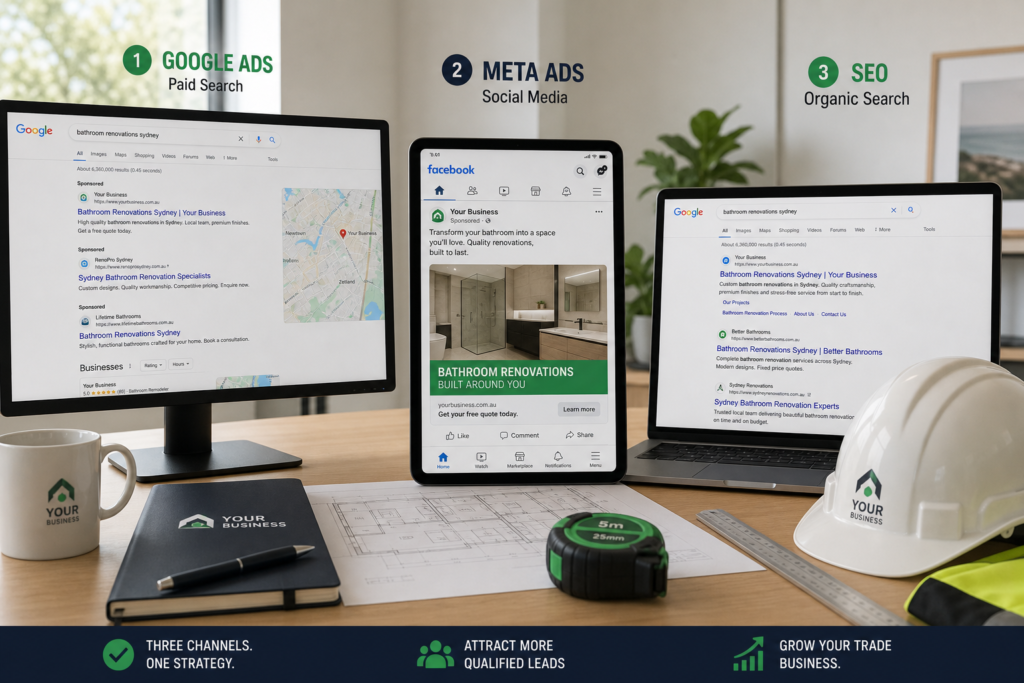
Google Ads vs Facebook Ads vs SEO – Where Should a Tradie Spend First?
You’ve got $2,000 a month to spend on marketing. Maybe $3,000. You know you need to “do something online” but every agency, every podcast, and every bloke at the trade show is telling you something different.
Google Ads. Facebook Ads. SEO. Content marketing. Social media. Email. AI.
Where do you actually start?
This is the question we get asked more than any other. And the answer isn’t “do everything.” The answer is: it depends on where your business is right now.
The Three Channels – What They Actually Do
Before we compare them, you need to understand what each one does. Because they’re not interchangeable. They do different jobs at different stages of the buying process.
Google Ads – Catching People Who Are Searching Now
When a homeowner’s hot water system dies at 6am, they grab their phone and type “emergency plumber near me.” Google Ads puts your business at the top of that search result.
This is intent-based advertising. The customer already has the problem. They’re actively looking for someone to fix it. Your ad appears at the exact moment they need you.
Google Ads work fast. You can launch a campaign today and get calls tomorrow. The leads are warm because the person was already searching. The downside is that you pay per click, and costs vary by trade and location. Competitive markets like plumbing in Sydney can run $15-30 per click. Less competitive markets might be $3-8.
We’ve covered Google Ads for tradies in detail – what it costs, what results to expect, and whether it’s worth it.
Facebook/Meta Ads – Creating Demand Before People Search
Facebook Ads work differently. Instead of catching someone who’s already searching, you’re putting your business in front of people who might need you but haven’t started looking yet.
A homeowner scrolling through Facebook sees a before-and-after of a bathroom renovation you just finished. They’ve been thinking about updating their bathroom for months. Your ad plants the seed. They tap the form. Now they’re a lead.
Facebook is powerful for trades that sell considered purchases – renovations, solar, new builds, pools, landscaping. It’s less effective for emergency or reactive work because those people search Google when the problem hits, they don’t browse Facebook.
The leads are typically cooler than Google leads. They need more follow-up. But the cost per lead is often lower, and the volume can be higher.
SEO – Building an Asset That Generates Leads for Free
SEO (Search Engine Optimisation) is the process of getting your website to rank organically in Google – the free listings below the ads. When someone searches “electrician Parramatta” and your website appears on page one without paying for the click, that’s SEO.
The advantage is obvious: once you rank, the leads are free. You’re not paying per click. Every enquiry from organic search is pure margin.
The disadvantage is time. SEO doesn’t work overnight. It takes 3-6 months to start seeing results, and 6-12 months to build real momentum. It requires consistent investment in content, technical optimisation, and link building.
But once it compounds, it’s the most cost-effective marketing channel for any trade business. We’ve written the definitive SEO guide for tradies if you want the full picture.
So Where Should You Spend First?
Here’s the honest framework we use with every client. It’s based on where your business sits today – not where you want it to be in two years.
Stage 1 – You Need Leads Now (Start With Google Ads)
If you need the phone to ring this week, Google Ads is the move. Nothing else works this fast for trade businesses.
Google captures existing demand. People are already searching for your service. You just need to show up at the top.
Invest here first if:
- You have capacity to take on more work
- You need leads within days, not months
- You have a follow-up system (CRM) in place to handle enquiries
- You have at least $1,500-3,000/month for ad spend plus management
Don’t start here if:
- You can’t handle more work right now (fix fulfillment first)
- You have no system for tracking and following up leads
- Your budget is under $1,000/month
Stage 2 – You Want to Scale (Add Facebook Ads)
Once Google Ads is running profitably and your lead management system is working, Facebook Ads adds a new layer of growth.
Facebook reaches people Google can’t – the ones who need your service but haven’t searched yet. It fills the top of your pipeline and creates demand instead of just capturing it.
Add Facebook when:
- Google Ads is profitable and stable
- Your CRM is handling lead follow-up properly
- You have visual content (before/after photos, video testimonials)
- You have capacity to handle increased lead volume
- You want to grow beyond what Google search volume allows
Stage 3 – You Want Long-Term Independence (Invest in SEO)
SEO is the long game. It takes months to build, but once it compounds, it reduces your dependence on paid ads.
Think of it this way. Google Ads is renting attention. SEO is owning it. When you stop paying for ads, the leads stop. When you rank organically, the leads keep coming even if you pause your ad spend.
Start SEO when:
- You’ve committed to at least 6-12 months of investment
- You understand it’s a compounding asset, not an instant fix
- You have a website that’s worth ranking (properly built, fast, mobile-friendly)
- You want to build long-term competitive advantages
The trade businesses that dominate their markets run all three. Google Ads for immediate leads. Facebook Ads for volume and awareness. SEO for long-term organic growth. But they didn’t start all three at once. They built them in sequence.
The Mistake Most Tradies Make
They try to do everything at once with not enough budget for any of it.
$1,500 a month split across Google Ads, Facebook Ads, and SEO means $500 for each. That’s not enough to run effective campaigns on any platform. You end up with mediocre results across the board and conclude that “online marketing doesn’t work.”
It does work. But it works when you focus your budget where it’ll have the most impact and build from there.
The second mistake is starting with SEO when you need leads now. SEO is the right investment – but if you’re desperate for work next week, waiting 6 months for organic rankings isn’t practical. Start with ads for the short term. Layer SEO in for the long term.
We see this pattern constantly. It’s exactly what Matt means when he says marketing won’t fix a broken business – you need to fix the fundamentals first, then scale.
Budget Allocation by Business Stage
Here’s a rough guide to how trade businesses at different stages should allocate their marketing budget.
Just Starting Out ($1,500-3,000/month total)
- 80% Google Ads
- 20% Foundation SEO (Google Business Profile optimisation, basic website content)
- 0% Facebook Ads (not yet)
Growing and Profitable ($3,000-6,000/month total)
- 50% Google Ads
- 25% Facebook Ads
- 25% SEO
Established and Scaling ($6,000-15,000+/month total)
- 35% Google Ads
- 30% Facebook Ads
- 35% SEO and content
These are starting points, not rules. The actual split depends on your trade, your market, your competition, and your capacity.
What About Content Marketing and Social Media?
Content marketing (blogging, video, educational posts) and social media (organic posting on Facebook, Instagram, LinkedIn) sit underneath the three main channels. They’re not separate strategies – they’re fuel for the main channels.
Blog posts improve your SEO. Video content feeds your Facebook ads. Customer photos give you organic social content. Google reviews boost your Google Business Profile ranking.
The content doesn’t replace ads or SEO. It makes them work better.
If you want to understand how content and marketing systems work together, have a read of why you should own your marketing system.
Common Questions About Marketing Channels for Tradies
Can I just do SEO and skip ads entirely?
You can. But expect a 6-12 month ramp-up with minimal leads during that period. If you have enough work to sustain the business while SEO builds momentum, it’s a valid strategy. Most tradies can’t afford to wait that long without new leads flowing in.
Is Google Ads or Facebook Ads cheaper?
Cost per click is typically higher on Google, but cost per qualified lead can be lower because the intent is higher. Facebook often has a lower cost per lead, but those leads need more follow-up and have a lower close rate. You can’t compare them purely on cost – you need to compare cost per closed job.
What if I’m in a really competitive market?
Competitive markets (plumbing in Sydney, electrical in Melbourne) have higher ad costs. This makes SEO even more valuable long-term because organic clicks are free. In competitive markets, the businesses that invest in SEO early gain a significant advantage over the ones relying solely on ads.
Should I do my own marketing or hire an agency?
If you’re spending under $1,500/month on ads, doing it yourself can work – provided you’re willing to learn the platforms. Above $3,000/month, the cost of mistakes and missed optimisations usually exceeds the cost of professional management. We’ve got a guide on choosing the right marketing agency if you go the agency route.
How do I track which channel is actually generating revenue?
This is where your CRM becomes essential. Every lead should be tagged with its source – Google Ads, Facebook, organic, referral. At the end of the month, you can see exactly how much revenue each channel generated. Without this tracking, you’re flying blind.
What about TikTok, YouTube, or LinkedIn?
YouTube is valuable for building authority and trust – especially through project walkthroughs and educational content. LinkedIn works for commercial trades targeting builders, developers, and property managers. TikTok can generate attention but rarely generates qualified leads for trade businesses. None of these should replace the core three (Google Ads, Facebook Ads, SEO) – they’re supplementary.
Does word of mouth still matter?
Word of mouth is great. But it’s unpredictable and unscalable. You can’t control when someone refers you. You can’t increase it on demand. The businesses that grow sustainably combine word of mouth with owned marketing channels. We wrote about why word of mouth isn’t enough for trade businesses that want to scale.
How quickly can I expect ROI from each channel?
Google Ads: 1-4 weeks. Facebook Ads: 2-6 weeks. SEO: 3-12 months. The speed of return is inverse to the longevity. Ads give fast results but stop when you stop paying. SEO is slow but compounds over time.
The Right Order Matters More Than the Right Channel
Every channel works. Google Ads work. Facebook Ads work. SEO works.
The reason tradies fail at marketing isn’t because the channel is wrong. It’s because they started in the wrong order, spread their budget too thin, or didn’t have the backend systems to handle the leads.
Fix the system first. Then turn on the channels. In the right sequence.
If you want help mapping out which channels to prioritise and in what order for your specific business, book an Impact Roadmap Session. It’s a paid working session where you walk away with a documented strategy, not a sales pitch. And if you decide to work with us, we credit that back, so essentially it costs you zilch.