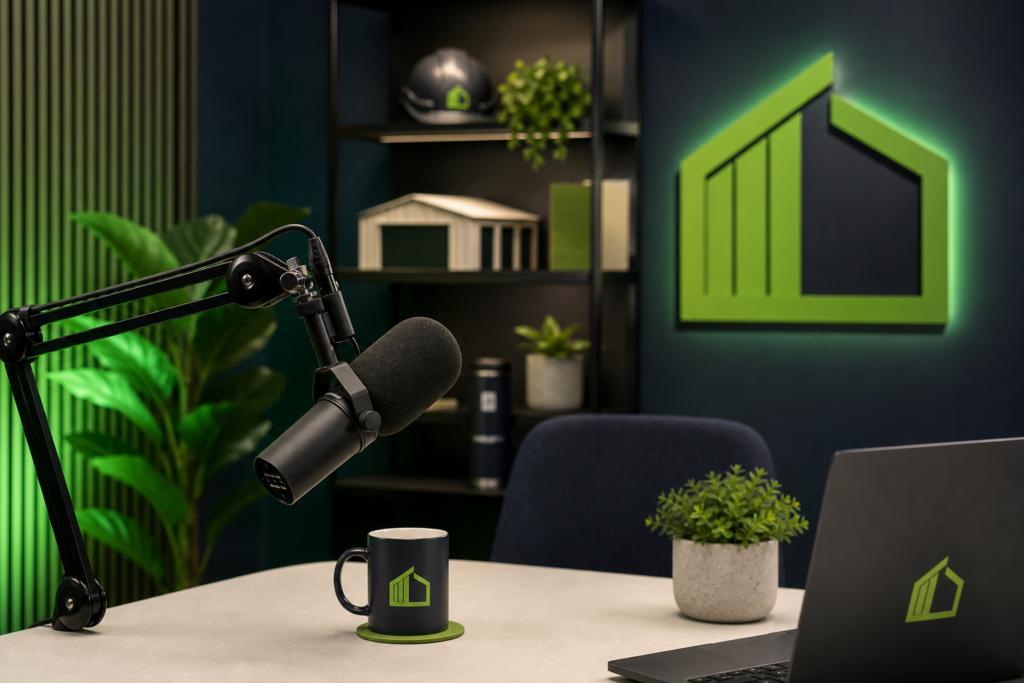
The Site Shed started because I was a former plumber with things to say and nowhere to say them. More than 500 episodes later, it’s become Australia’s number one business podcast for trade businesses — and an honest record of what actually works when you’re trying to grow a trade business from the tools to the boardroom.
This isn’t a story about overnight success or a vanity project. It’s about why content creates competitive advantage — and why most tradies still haven’t figured that out.
Why a Former Plumber Decided to Start a Podcast
When I left the tools and started Tradie Web Guys back in 2012, I noticed something that frustrated me.
There was no shortage of advice for tradies. Plenty of business coaches, plenty of marketing agencies, plenty of people claiming to know what trade business owners needed. But almost none of it came from people who’d actually held a spanner. They were talking about an industry they didn’t work in, to an audience they didn’t understand.
I’d been a plumber. I knew what it was like to build a business from the ground up while still being on the tools. I knew the feast-and-famine cycle. I knew what it felt like to have plenty of work but no idea where the next month’s work was coming from. I knew the specific frustrations — the quoting, the no-shows, the clients who’d get three quotes and go with the cheapest — that most business advice glosses right over.
So I started The Site Shed.
The original idea was simple: create a space where trade business owners could hear from other trade business owners. Real conversations about real problems. No theory, no hypotheticals — just people who’d been there and done it.
More than 500 episodes later, that’s still the brief.
What the Podcast Is Actually About
The Site Shed covers business, not just trade. That distinction matters.
Most tradespeople are good at their craft. They’re not always good at running a business. And there’s a gap between those two things that almost nobody teaches — how to go from being a skilled operator to being the owner of a business that works without you.
That gap is what we spend 500+ episodes talking about.
The topics range from marketing (lead generation, Google Ads, SEO, content strategy) to operations (systemising workflows, hiring, onboarding, managing teams) to the financial side (pricing, profit margins, cash flow, the Profit First methodology) to mindset (the mental load of being a business owner, the transition off the tools, building something that supports your life rather than consuming it).
It’s not all serious. Some episodes are proper deep-dives into strategy. Some are conversations with trade business owners about their wins and setbacks. Some are just me in teach mode, working through something I’ve seen repeatedly with clients.
The format that works best — and the one I keep coming back to — is guest conversations where the guest brings a specific lesson. Not a product pitch, not a CV rundown — a lesson. Something they’ve actually done, tested, applied, and can speak to with specifics.
That’s the standard. If a guest can’t deliver that, they don’t come on. There’s too much content in the world already built on borrowed credibility.
What 500 Episodes Actually Teaches You
Five hundred episodes is a lot of conversations. And over that span, you start to see patterns.
The businesses that grow are the ones that build systems. Not the ones that work the hardest, not the ones with the best tradies, not even the ones with the most leads. The ones with consistent processes for every part of the business — from how they answer the phone to how they follow up on quotes to how they onboard new staff.
The businesses that stay stuck are the ones where the owner is still the business. They’re the salesperson, the estimator, the scheduler, the problem-solver of last resort. They’ve built themselves a job, not a business. And no amount of marketing fixes that — it just gives them more of the same problems at higher volume.
That insight didn’t come from a book. It came from watching hundreds of conversations play out over more than a decade. It’s why the podcast exists — to compress that learning curve for people earlier in the growth process.
Episode 500 was a milestone episode — “The Lies Keeping Tradies Broke: What 500 Episodes Taught Me.” Worth a listen if you want the condensed version of everything we’ve learned across half a thousand conversations.
Notable Topics the Podcast Has Covered
A few of the areas we come back to repeatedly because they’re the ones that move the needle most:
Lead Management vs Lead Generation
The single most common misconception in the trades industry. Most business owners think they have a lead problem. In reality, they have a lead management problem — leads are slipping through the gaps between enquiry and follow-up, between follow-up and quote, between quote and conversion. We’ve covered this from about fifteen different angles across the podcast, because it keeps coming up with every type of trade.
Sales Process for Trade Businesses
Tradies are often good at selling to referrals and word of mouth. Put them in front of a cold lead and things get harder. The podcast has covered everything from response time (the data on this is pretty confronting — speed to lead matters more than most people realise) to building a proper follow-up sequence to how to price and present quotes in a way that commands premium positioning.
Hiring and Team Building
Covered exhaustively — because this is where most growth stalls. Episode topics have covered everything from writing job ads that attract the right people to onboarding processes to the uncomfortable reality of hiring slow and firing fast. And why a business can’t scale past the owner’s capacity unless the team is genuinely capable of running without constant hand-holding.
AI for Trade Businesses
More recent territory — but significant. The podcast has tackled this honestly, which means not pretending AI is going to replace everything next Tuesday, but also not dismissing it as irrelevant. Where AI genuinely helps (automated follow-up, content creation, phone answering systems) versus where it falls short (replacing human relationship-building in high-value trades sales) — we’ve tested a lot of this ourselves and talked about what we’ve found. AI content writing strategies for tradies is one example of where we’ve covered this in depth.
Marketing ROI and Budget Allocation
Not just “run some ads.” The deeper question — how do you know if your marketing is actually working, and how much should you be spending? The framework we use: marketing spend is an allocation of your revenue target, not a percentage of what you’ve got spare. That reframe alone changes how most business owners think about the investment.
Business Systems and Productisation
The transition from doing jobs to building a business. Systemising everything that can be systemised, so the business can operate without the owner in the middle of every decision. Topics have ranged from workflow documentation to software tools to the mental shift required to actually let go of things you used to do yourself.
Why Content Creates a Competitive Moat for Tradies
Here’s the thing about 500+ episodes of podcast content.
It doesn’t just live in podcast apps. It becomes SEO content, video content, email sequences, social posts, and blog articles. Every episode is a spoke that feeds off a pillar. And that content positions Tradie Web Guys — and the guests we feature — as the trusted source of information in this space.
Most tradies I talk to understand this intellectually but underestimate how much it compounds.
They know they should be creating content. They know it would position them as the expert in their area. They know their competitors aren’t doing it — which means there’s an open run for anyone willing to put the work in. But they don’t do it because they’re uncomfortable in front of a camera, or they don’t know what to say, or they’re too busy on the tools to think about strategy.
I’ve sat with clients and watched them explain their craft to a homeowner with genuine conviction — detailed, specific, authoritative. The second we hold a camera up, they clam up.
That’s not a content problem. That’s a friction problem. Remove the friction (right format, right support, right strategy) and the content starts flowing.
The businesses that build content moats in their local area — that become the go-to resource for “how to maintain your solar panels in winter” or “what causes burst pipes in older homes” or “how to know if your switchboard needs upgrading” — are the ones that don’t have to fight on price. People already trust them before they’ve even made contact.
The Site Shed is proof of concept for this at the agency level. The same strategy works at the local trade business level. It just takes a slightly different execution.
How The Site Shed Connects to What We Do at TWG
The podcast isn’t a marketing vehicle for Tradie Web Guys. It’s more foundational than that.
It’s the reason we have the authority to help the businesses we help. Not because we’ve said we’re experts — because we’ve shown the work, episode after episode, for more than a decade. Anyone can claim expertise. Half a thousand episodes of genuine, consistent, practical content is harder to fake.
The connection to TWG is organic. Listeners who’ve followed the podcast for a year or two already understand our worldview — that you don’t have a lead problem, you have a lead management problem; that marketing won’t fix a broken business; that the system matters more than the tactics. By the time they book an Impact Roadmap session, they’re not a cold prospect. They already know how we think.
That’s the thing about earned authority versus bought attention. When someone finds you through a paid ad, they’ve got no context for who you are and whether they should trust you. When someone’s been listening to your podcast for 18 months, they do.
It’s not borrowed attention. Not random referrals. Not waiting for someone to mention your name at a barbeque. It’s a media asset that works while you sleep.
The Site Shed and Social Media — Why Content Strategy Matters
The podcast is the pillar. But it doesn’t live in isolation.
Every episode generates supporting content — clips for social media, show notes for SEO, email recaps for the list, LinkedIn posts from the key insights. Social media for tradies works best when it’s built off something real and specific — a real result, a real client story, a real lesson from a real conversation.
Manufactured content that exists purely to fill a posting schedule is obvious. Audiences can smell it. The tradies and business owners who follow The Site Shed aren’t following it for filler — they’re following it because the conversations are genuine and the lessons are applicable.
That’s the standard we hold guests to. That’s the standard we hold ourselves to.
What 500 Episodes Tell You About the State of the Industry
Honestly? There’s been a lot of change since episode one.
The tools have changed. Google Ads in 2012 looked completely different to Google Ads in 2025. AI has arrived and it’s doing things that weren’t possible even three years ago. The way homeowners find tradies has shifted dramatically — ranking in AI-powered search results is a real conversation we’re having now that didn’t exist two years ago.
But some things haven’t changed at all.
Trade business owners still struggle with the same core problems they always have — too dependent on the owner, not enough predictability, no real marketing system, leads dying in the inbox. Those problems were there in episode one. They’re there in episode 500. The solutions have evolved but the problems are depressingly consistent.
Which is, truthfully, why the podcast still has plenty to say.
Who Should Be Listening
If you’re a trade business owner at any stage of growth — whether you’re still on the tools building toward your first hire, or you’re running a team and trying to build the business to the point where you could step away — there’s something in the archive for you.
The most downloaded episodes tend to be the ones about sales and lead management (because that’s where the immediate pain is) and the ones about getting off the tools and building a team (because that’s the transition point most owners find hardest).
But honestly, the best use of the podcast is not as background noise while you’re on the road. It’s as a deliberate education resource. Pick the topics that apply to where you are right now. Go deep on one thing. Apply it. Come back for the next one.
That’s how the businesses that actually grow use it.
Frequently Asked Questions
What is The Site Shed podcast?
The Site Shed is an Australian business podcast specifically for trade business owners — builders, plumbers, electricians, roofers, solar installers, HVAC, landscapers, and related trades. It covers marketing, operations, sales, hiring, systems, and the business of running a trade company. Hosted by Matt Jones, founder of Tradie Web Guys and former plumber. More than 500 episodes published since its launch.
How many episodes does The Site Shed have?
Over 500 episodes. The podcast has been running since Tradie Web Guys was founded, with consistent output over more than a decade. Episode 500 was a milestone episode titled “The Lies Keeping Tradies Broke: What 500 Episodes Taught Me.”
Where can I listen to The Site Shed?
The Site Shed is available on all major podcast platforms — Apple Podcasts, Spotify, Google Podcasts, and others. Episodes are also published on the Tradie Web Guys YouTube channel.
Is The Site Shed only for Australian tradies?
Primarily yes — the content is written for Australian trade businesses and uses Australian context, references, and examples. Plenty of the topics (lead management, business systems, hiring, pricing, marketing) are directly applicable for trade business owners in the UK, US, Canada, and New Zealand, so the listenership is broader than it might look.
Who are the guests on The Site Shed?
Guests include trade business owners at various stages of growth, marketing specialists with direct trade business experience, business coaches, operations experts, finance specialists, and occasionally people from adjacent industries with genuinely useful lessons. The standard is: the guest brings a specific lesson based on something they’ve actually done — not a general overview, not a product pitch.
Does The Site Shed promote Tradie Web Guys services?
There’s a CTA for Tradie Web Guys at the end of episodes, and the podcast naturally reflects the worldview that underpins the agency. But the content itself isn’t a sales channel — it’s a genuine education resource. If you’ve been listening for a while and want to explore working with TWG, the Impact Roadmap session is the starting point.
What are the most popular episodes?
High-download topics consistently include: sales processes for trade businesses, lead management and CRM, getting off the tools and building a team, pricing and profit margins, and more recently, AI applications for trade businesses. Episode 500 — the milestone retrospective — is among the most listened.
Why should a tradie listen to a podcast instead of just Googling what they need?
Google is great for specific questions. The podcast is better for perspective shifts — the kind that come from hearing how other business owners have navigated the same problems you’re facing. The specific tactical advice is useful. But the bigger value is in the cumulative exposure to how successful trade business owners think differently about their business. That’s harder to Google.
Want to Build the Kind of Business That Actually Grows?
If you want help auditing your current setup and building a marketing system that belongs to you, book an Impact Roadmap Session. We will walk through every platform, every account, and every asset, then build a plan to put you in full control of your marketing infrastructure.