A tradie website in Australia costs anywhere from $0 to $15,000+ depending on who builds it and what you actually need it to do. The real question isn’t what it costs to build — it’s what it costs you when it doesn’t work.
Most tradies shopping for a website are comparing price tags. That’s the wrong comparison. A $500 website that generates zero leads costs you more than a $7,000 website that books three jobs a month before you’ve had your morning coffee.
So let’s break it down properly. What the different tiers actually include, what the new wave of AI and vibe-coded websites are about, and why the cheapest option almost always ends up being the most expensive decision you make.
The Four Website Tiers for Tradies in 2026
DIY and Template Websites: $0–$500
This is the Squarespace, Wix, and Canva territory. You pick a template, drag a few things around, upload a photo of your ute, and call it done.
The upside? Fast. Cheap. You own the monthly subscription.
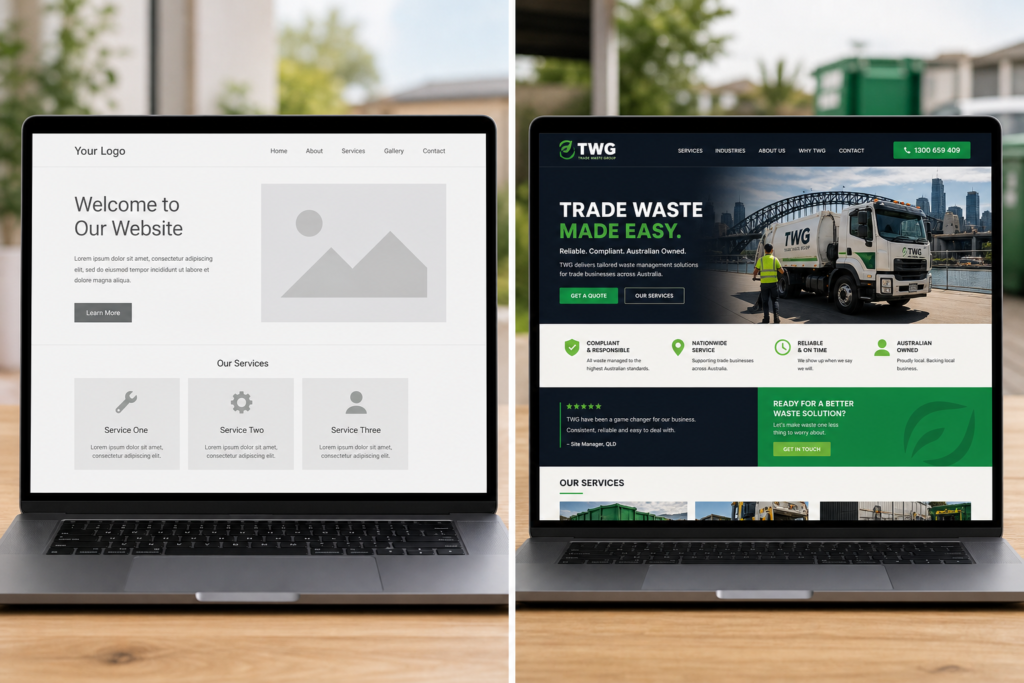
The downside? Google doesn’t care about pretty. Template websites are built for everyone — which means they’re optimised for no one. They typically load slowly, have limited SEO control, can’t handle the technical structure a trade business needs to rank locally, and they all start to look the same after about three clicks.
If you’re a solo operator just wanting something online while you build the business, a template site can get you started. But if you’re trying to grow past word-of-mouth, you’ll hit a ceiling quickly.
And the moment you want to actually change something meaningful — swap the layout, add a landing page, integrate a CRM — you’re either paying a developer to fight the template, or you’re stuck.
Freelancer-Built Websites: $2,000–$5,000
This is a genuine step up. A freelancer (usually working through platforms like Upwork, Fiverr, or their own referral network) will build you something that looks polished and is probably better for SEO than a template.
The catch: you get what they know, not what your business needs.
Most freelancers are generalists. They’re building sites for yoga studios this week and plumbers next week. They don’t know that your conversion rate depends on a click-to-call button being above the fold on mobile. They don’t know that your quote form needs to be on every service page. They don’t know how to structure location pages that help you rank in the suburbs you actually work in.
The work is fine. The strategy is missing.
You’ll also find yourself stuck down the track. Need to update it? Back to the freelancer. Want to add a service page? Back to the freelancer. They’re unavailable for three weeks? Your site sits broken.
Professional Agency Website: $5,000–$15,000+
This is where strategy enters the build.
A proper trade-business website built by a team that understands your industry will include custom design, mobile-first builds, page speed optimisation, local SEO structure, schema markup, conversion-focused layouts, CRM integrations, and content written to rank for the searches your customers are actually typing.
It’s not just pages. It’s a lead generation machine — or at least, it should be.
The investment is higher upfront. But if your average job is worth $3,000 and the site consistently books an extra two jobs a month, it’s paid off in six weeks. After that, it’s pure return.
That’s the maths tradies skip when they’re comparing price tags.
What About AI and Vibe-Coded Websites?
This one needs its own section because it’s the new shiny thing — and there are real traps in it.
Platforms like Lovable, Bolt, and v0 have made it possible for anyone to “build” a website by describing what they want in plain English. You type something like “build me a plumbing website with a contact form and service pages” and five minutes later, you’ve got something that looks like a website.
Fast? Yes. Impressive? At first glance.
But here’s what you need to understand before you go down that path.
You Don’t Own It — You Rent the Platform
When you build on Lovable or a similar vibe-coding platform, the site exists on their infrastructure. You don’t own the underlying code in a way that’s easily portable. If they change their pricing, get acquired, pivot the product, or shut down — your site goes with them.
That’s renting, not owning. And the difference between owning your marketing system versus renting it is one of the most important decisions you’ll make for your business long-term.
The SEO Problem Is Real
Vibe-coded sites are typically hard-coded. The structure is baked in at generation time. You can’t easily add new pages, restructure the URL architecture, adjust page titles and meta descriptions, or add the schema markup that tells Google exactly what your business does and where you operate.
For a trade business that relies on local search — and almost every trade business does — that’s a significant problem.
Google doesn’t rank websites. It ranks pages. And every page needs to be built with specific intent, specific keyword targeting, and specific local signals. A vibe-coded site generated in five minutes doesn’t have any of that. It has a homepage, a contact form, and whatever you described in the prompt.
The Design Is Cookie-Cutter
AI-generated websites look fine. They also look like every other AI-generated website.
Your customers aren’t consciously noticing this. But they are noticing that your site doesn’t feel like you. There’s no story. No personality. No evidence that you’re the obvious choice for the job.
In a market where trust is everything — and in the trades, trust is everything — generic design is working against you before a single word is read.
No Custom Conversion Optimisation
The reason professional websites cost what they cost isn’t the design hours. It’s the thinking behind the design.
Where does the form go? What does the headline say? What proof elements reduce friction at the decision point? What does the mobile experience look like when someone’s on the side of the road trying to find a plumber?
A vibe-coded site doesn’t know any of that. It generates a plausible-looking page. Whether it actually converts visitors into enquiries is another question entirely — one that AI prompts can’t answer without specific knowledge of your trade, your customer, and your market.
They Can’t Migrate Easily
If you decide six months later that your vibe-coded site isn’t cutting it and you want to move to a proper WordPress build, you’re essentially starting over. The design assets may not export cleanly. The content is tied to the platform’s structure. You’ve lost time and you’re back to zero.
It’s not a stepping stone. It’s a detour.
So Why Do Cheap Websites End Up Costing More?
A trade business owner once told me they’d had four websites in five years. Each one was “affordable.” Each one was supposed to solve the problem. Each one failed.
By the time they came to us, they’d spent more across those four websites than a single properly built site would have cost — and they still had nothing generating leads.
That’s the trap. You’re not buying a website. You’re buying the leads that come through it. A website that generates zero leads has zero return, regardless of what you paid for it.
The maths is simple. If your website costs $7,000 and generates $4,000 worth of work per month, it’s paid off in two months. If your $500 template site generates nothing, you’ve saved $6,500 and made nothing.
Which option is actually cheaper?
What You’re Actually Buying With a Professional Tradie Website
When you invest in a properly built website, you’re not buying pretty pages. You’re buying:
A local SEO foundation. The page structure, URL hierarchy, service pages, and location pages that tell Google exactly what you do and where. That’s what gets you ranking for “plumber Norwood” or “electrician Gold Coast” — not a nice-looking homepage.
A mobile-first experience. More than 60% of search traffic for trade businesses comes from mobile. If your site doesn’t load fast and convert well on a phone, you’re losing most of your potential customers before they read a word.
Conversion infrastructure. Click-to-call buttons, above-the-fold forms, trust signals (reviews, licences, photos), and page layouts built to move a visitor from “found your site” to “sent an enquiry.” That’s not decoration — it’s revenue.
Schema markup and technical SEO. The behind-the-scenes code that tells Google you’re a licensed plumber in Brisbane, not a plumber supply store in the US. Without it, you’re leaving ranking potential on the table.
Speed. A site that loads in under two seconds ranks better and converts better. A slow site loses the visitor before the page has finished loading. That’s a conversion problem and an SEO problem at the same time.
Integration capability. Forms that pipe leads into your CRM. Call tracking. Google Analytics. Google Search Console. These aren’t optional extras — they’re the measurement layer that tells you whether your marketing is working.
The TWG Approach: Custom WordPress, Not Rentals
We build on WordPress. Always have.
Not because it’s the only option — but because it gives clients full ownership. You can export everything, move hosting providers, bring in any developer in the world, and never be held to ransom by a platform’s pricing change or policy update.
We don’t build on page builders that tie you to a subscription. We don’t build on proprietary systems that evaporate if the company pivots. We build websites that our clients own outright.
There’s a reason we’ve been doing this since 2012.
The sites we build are conversion-first, mobile-first, and SEO-built from the ground up. They’re designed specifically for trade businesses — not adapted from templates built for restaurants or accountants.
And they’re built as part of a broader system. A website that doesn’t connect to your CRM, your Google Business Profile, your review collection process, and your ad campaigns isn’t a marketing asset. It’s a brochure. There’s a meaningful difference between a website that gets you found versus a website that actually closes you work.
“But I Just Need Something Simple”
Heard that one before.
The businesses that say they just need something simple are usually the ones that come back two years later with a lead problem — and it’s because their “something simple” wasn’t generating anything.
A simple website and a simple business are two different things. Your business isn’t simple. You’ve got licences, liability, scheduling, quoting, trade-specific SEO challenges, local competition, and customers doing research before they call.
Your website needs to handle all of that. That’s not complicated for the right builder. But it does require someone who understands trade businesses specifically — not someone who builds generic sites.
If you want to understand exactly what the non-negotiables are, we’ve covered the 10 must-have features for a high-converting tradie website in detail elsewhere.
What Affects the Price?
If you’re getting quotes and wondering why the range is so wide, here are the variables:
Number of pages. A five-page brochure site is different to a 30-page site with individual service pages, suburb-specific location pages, and a blog.
Custom design vs template. A fully custom design takes more time and costs more. It also looks more like your business and less like everyone else’s.
Copywriting. Good website copy is written for humans and optimised for search. It’s not just describing your services — it’s persuasion architecture. If your agency is writing it for you, that’s included. If you’re writing it yourself, that’s a cost you’re taking on.
SEO setup. On-page SEO, technical SEO, schema markup, Google Business Profile integration — these are often quoted separately, and they matter a lot.
Integrations. CRM connections, booking tools, chat systems, job management software — if you want these, they add to the build.
Ongoing support. A website maintenance plan covers updates, security, backups, and performance monitoring. Some agencies include this; others quote it separately.
The Real Question to Ask Any Web Agency
Not “how much does it cost?” — but “what does this website need to do, and how will we know if it’s working?”
If they answer that question with confidence and specificity, you’re talking to someone who builds websites that generate business.
If they show you pretty templates and talk about colours, you’re in for an expensive disappointment.
FAQs
How much should a tradie website cost in Australia?
For a trade business serious about lead generation, expect to invest $5,000–$12,000 for a professionally built site. DIY templates run $0–$500 but rarely convert. Freelancers sit in the $2,000–$5,000 range but often lack trade-specific strategy. The right number depends on your average job value and growth targets — not what feels affordable.
Are AI website builders like Lovable or Bolt good for tradies?
They’re fast and cheap upfront, but they come with significant limitations for trade businesses. You don’t own the underlying infrastructure, SEO control is limited, designs are generic, and migration is difficult if you want to upgrade later. For a trade business relying on local search traffic, these platforms create more problems than they solve over the medium term.
Can I build my own tradie website?
Yes. Platforms like Squarespace and Wix make it accessible. But “accessible” doesn’t mean “effective.” The conversion rate, page speed, local SEO setup, and technical structure of a DIY site will typically fall short of what a professional build delivers. If you’re in a competitive trade market, the DIY approach will likely cost you in missed leads faster than the build cost savings justify.
What’s the difference between a website and a marketing system?
A website is a page on the internet. A marketing system is a connected infrastructure — website, CRM, Google Business Profile, review collection, ads, and analytics — that generates and closes enquiries consistently. A website alone is a starting point, not a solution.
Why does TWG build on WordPress?
Because WordPress gives clients full ownership of their site. You own the code, the content, the domain, and the data. No platform lock-in, no subscription dependency, no risk of your site disappearing because a startup pivoted. Ownership matters — particularly when your website is your primary lead source.
How long does it take to build a tradie website?
A professionally built trade website typically takes 4–8 weeks from brief to launch, depending on complexity, the number of pages, and how quickly the client provides content and approvals. Template-based builds can be faster, but the timeline compression often shows in the result.
What ongoing costs should I expect after the website is built?
Expect to budget for hosting ($20–$100/month), domain registration ($15–$30/year), website maintenance and security ($100–$300/month depending on the plan), and potentially SEO services on top. These aren’t optional extras — they’re the ongoing cost of keeping a business asset functioning.
Does a more expensive website always perform better?
No. Price reflects the quality of the build, strategy, and expertise behind it — but an expensive website built without trade-specific knowledge can still underperform. The question isn’t “is this expensive?” It’s “is this built by someone who understands what makes a trade business website actually generate leads?”
If you want to know exactly what your current website is missing and what it would take to make it a genuine lead source, book an Impact Roadmap Session. We’ll walk through your site, your market, and your competitors, then build a plan that puts your marketing working for you — not against you.