You’re Paying for Leads You Never Properly Follow Up
If your answer to “we need more work” is “we need more leads”, there’s a fair chance you’re about to spend more money on the wrong thing.
Most trade businesses don’t lose work because demand disappears. They lose it after the enquiry lands. The call takes too long. Nobody qualifies the job. A quote goes out late. A site visit gets booked for someone who was never a fit. Then the lead is called once, maybe twice, and written off as poor quality.
That is a lead management problem.
The difference matters because every lead you buy has already cost you money. If you haven’t built a process to respond, qualify, follow up, quote and track the outcome, buying more leads simply gives you more chances to waste them.
This guide shows trade business owners where enquiries usually die, what a proper lead management process looks like, and which numbers tell you whether you are actually improving.
What is lead management for tradies?
Lead management is the process a business uses to turn an incoming enquiry into a booked and completed job. For a tradie, it covers every step from the first phone call, web form or Facebook lead through to qualification, follow-up, quoting, site visit, close and reporting.
A proper system gives the team a clear answer to a few simple questions:
- Who owns the next action on every lead?
- How quickly did we respond?
- Is this job a fit for the business?
- How many contact attempts have been made?
- Has a quote been sent and followed up?
- Where did the lead stop moving, and why?
Without those answers, “the leads are rubbish” is usually a guess.
The job is the KPI. Site visits are a step in the process.
A common KPI for office staff or call takers is site visits booked. It feels productive. It also pushes the business to send estimators out to people who have not been properly qualified.
The KPI that pays the wages is closed jobs. Site visits are only useful when they are leading to profitable work.
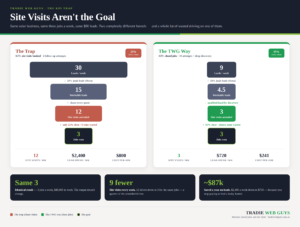
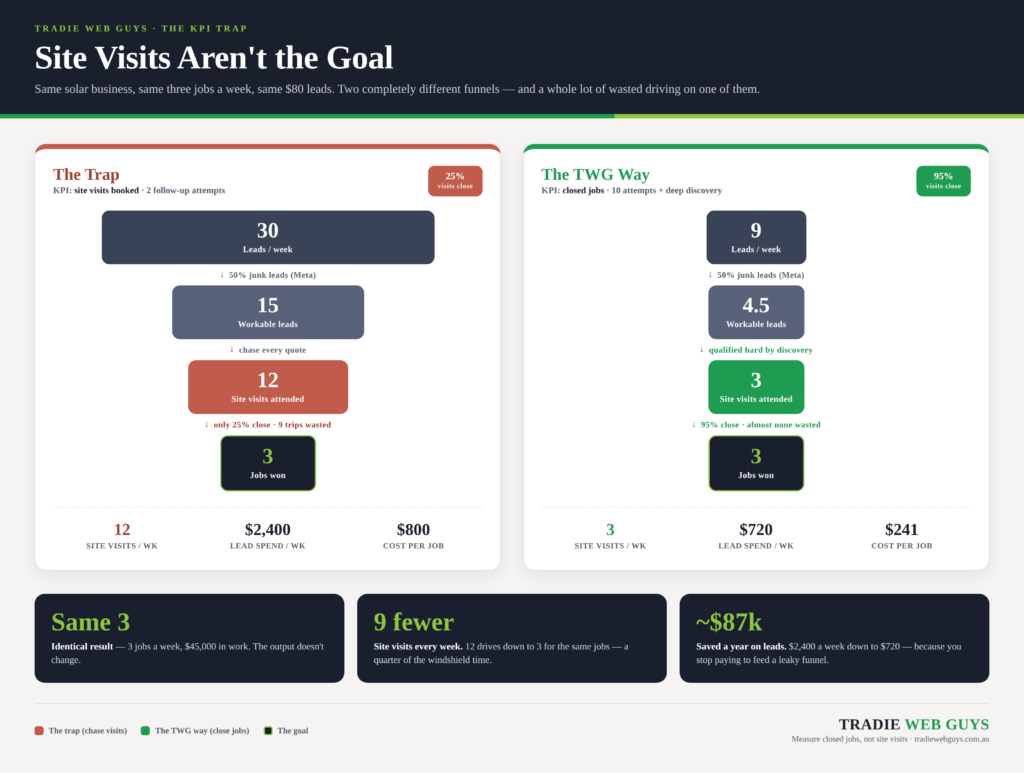
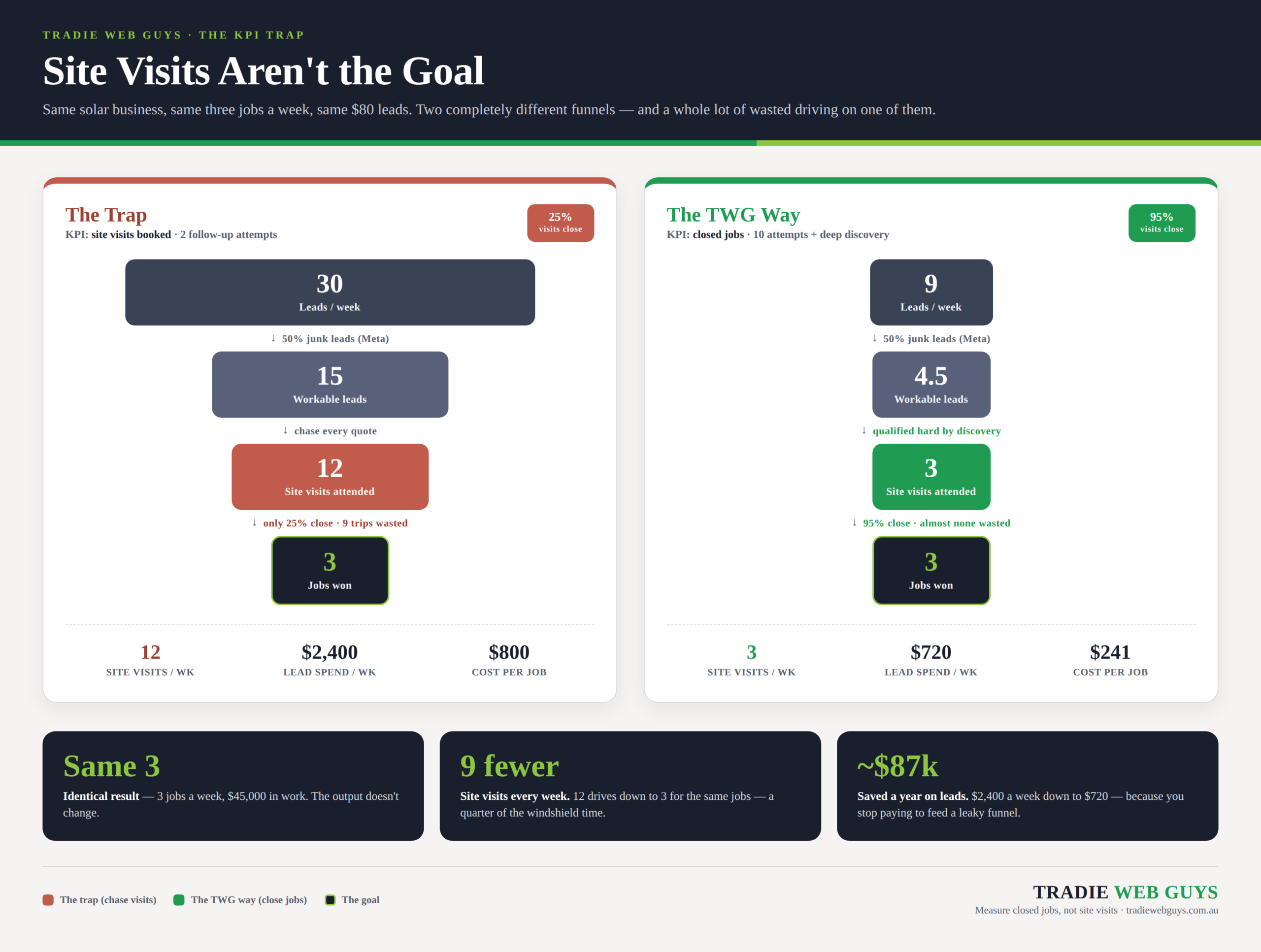
The supplied funnel makes this clear. In the example, both businesses win 3 jobs a week from leads costing $80 each. The first business chases volume: 30 leads, 15 workable leads and 12 site visits to get those 3 jobs. At $2,400 in weekly lead spend, its cost per job is $800.
The second business uses early qualification and deeper follow-up. It needs 9 leads, 4.5 workable leads and 3 site visits for the same 3 jobs. Weekly lead spend is $720 and the cost per job is $241.
The result stays the same. The wasted time and money do not.
Those figures are an illustrative funnel from the supplied video and diagram, not a promise of a specific result. Your conversion rates will depend on your trade, market, price point, capacity, lead source and sales process. The principle holds: a tighter process makes each paid enquiry worth more.
Where leads die in a trade business
Slow first response
A lead who has filled in a form is often contacting more than one business. A quick first response gets you into the conversation while the job is still front of mind. A delayed response gives the prospect time to move on, call someone else, or forget why they enquired.
The benchmark in the video is to respond within 5 minutes where possible. That requires ownership and automation. If the office is busy, the system needs to acknowledge the lead, alert the right person and show that the enquiry has been received.
Weak qualification
Not every enquiry deserves a site visit. A good qualification conversation establishes the type of work, location, timeframe, budget expectations, decision-makers and whether the job sits inside your service area and capacity.
Disqualifying unsuitable leads early is not rude. It protects the time you need for workable jobs. The aim is not to book every person in. The aim is to book the right work.
One call, then silence
Many businesses treat one unanswered call as a dead lead. Project-based work rarely moves that neatly. People are at work. They are comparing options. They need to speak to a partner. They are simply busy.
The video’s operating standard is at least 10 contact attempts across call, SMS and email, with a minimum of 2 call attempts a day for the first 5 days before a lead is written off. Use this as a process benchmark to test, not a reason to harass people. Each contact should be relevant, polite and easy to respond to.
Quotes without a follow-up process
A quote sent is not a job won. It is the beginning of the decision period. If your team sends quotes on Friday and waits for the customer to call back, the follow-up process is doing nothing for you.
Every quote needs a next step, an owner, a due date and a reason code if it is lost. That gives you a sales process you can improve rather than a pile of unanswered PDFs.
No single source of truth
Leads disappear when they live across missed calls, inboxes, notebooks and staff phones. A CRM gives the team one place to record the source, contact history, qualification notes, appointment, quote, outcome and next action.
For the software side of this decision, read our guide to . The important part is the process you run inside it. Software cannot follow up on work your team has not agreed to own.
CRM for tradies
The lead management process that turns enquiries into jobs
1. Capture the enquiry immediately
Every lead source should land in one system with a source label. Phone calls, web forms, Google Ads, Meta leads, referrals and chat messages should not be handled as separate, invisible pipelines.
Set up an automatic acknowledgement for out-of-hours leads. It should confirm that the enquiry landed and set a realistic expectation for contact. Do not promise a call in 5 minutes if nobody is available.
2. Make first contact fast
Assign a person, not a department. The lead owner attempts contact promptly, records the outcome and schedules the next action before moving on.
A missed call should create a task. An unanswered form should create a task. A lead without a next action should be an exception the team can see.
3. Qualify before you send a vehicle
Build a short script around the information your business needs to price and deliver the work. Keep it practical:
- What work do you need done?
- Where is the job?
- When do you need it completed?
- Have you spoken with anyone else or received quotes?
- Who will make the final decision?
- Is there anything about access, scope or budget that changes whether the job is suitable?
The exact questions vary. An emergency plumber handles urgency differently from a solar installer or a renovation builder. The rule stays the same: the site visit should be a meaningful step towards a job, not a substitute for a discovery conversation.
4. Follow up with a defined cadence
Write the cadence down. It should cover the first few days after the lead arrives, the period after an appointment is booked, the period after a quote is sent, and longer-term nurture for leads who are not ready yet.
Calls, SMS and email can work together. The message should move the conversation forward: confirm availability, answer a question, offer a booking time, check whether the quote was received, or ask what is stopping the decision. Avoid generic “just checking in” messages that create no reason to reply.
5. Quote quickly and make the next action obvious
Slow quotes kill momentum. Put a target turnaround time around your quoting process, then measure it. Make the quote easy to understand, clear about scope and clear about the next step.
Before the quote goes out, schedule the follow-up. Do not leave this to memory. A quote with no follow-up date is a lead you have chosen to lose track of.
6. Track the outcome and reason
Every lead should end in a stage that means something: qualified, disqualified, appointment booked, quoted, won, lost or nurture. If it is lost, record why where possible: price, timing, no response, outside area, competitor, finance or job not suitable.
That is where useful improvement starts. If Meta leads are creating appointments but not quotes, the issue is different from a lead source that never produces workable enquiries. If quotes are being sent but not accepted, the issue may sit in price, sales conversation, turnaround time or the proposal itself.
The numbers worth tracking
Lead count is useful. On its own, it tells you almost nothing about business performance. Track the conversion chain through to closed work.
Review these weekly. The point is to find the stage with the biggest drop-off, give one person responsibility for fixing it, and see whether the number changes. A business that tracks each stage can coach the right behaviour. A business that only tracks leads has no idea where the loss occurred.
Cold leads need a different sales process to referrals
Many established tradies are good at closing referrals. The customer already knows someone who trusts them. The conversation starts warm.
Leads from Google, Facebook or a website have not had that introduction. They may be comparing 3 businesses. They may not know what a fair price looks like. They may be cautious because they have had a bad experience before.
That does not mean the lead is rubbish. It means the business needs a proper sales process for cold traffic: fast contact, clear qualification, proof, consistent follow-up, confident quoting and a record of what happened.
If you are spending on ads, pair that spend with the process required to handle the conversations the ads create. Read our guide on “Google Ads for tradies: costs, results and whether it is worth it”
What a CRM should do for a trade business
A CRM is useful when it removes the blind spots above. It should capture leads, assign ownership, create follow-up tasks, keep communication history, track appointments and quotes, report outcomes and show the next action for every active opportunity.
Tradie Hub brings those functions into one place for trade businesses, including lead capture, automated follow-up, pipeline visibility and customer communication. It is part of the wider system we use to make sure marketing activity leads somewhere useful after the enquiry lands.
Do not buy a CRM because someone says it will make your business run itself. Buy it when you are ready to define the stages, standards and responsibilities it will enforce.
A 7-day lead management audit
You can find a lot in a week. Pull every lead received in the last 7 days and review it against the list below.
- Was every lead recorded in one system?
- Did every lead receive a fast first response or acknowledgement?
- Is the source recorded?
- Was the job qualified or disqualified with a reason?
- Does every active lead have a future next action and an owner?
- Were quotes sent within your agreed turnaround time?
- Did every quote receive the planned follow-up?
- Can you name the number of jobs won, the value won and the cost per job?
Start with the largest gap. If response time is slow, fix ownership and notifications. If quote follow-up is weak, create the tasks and scripts. If site visits are being wasted, improve qualification before you send anyone out. Do not try to change 12 things at once.
Frequently asked questions
How quickly should a tradie respond to a lead?
As quickly as the business can reliably manage. The source video uses 5 minutes as the target for a first response. If a human cannot call within that window, send an honest acknowledgement immediately and make the next contact task visible to an owner.
How many times should you follow up a lead?
The video recommends at least 10 contact attempts before writing off a project-based lead, with 2 call attempts a day for the first 5 days. Treat that as a process standard to test against your market and customer expectations. Follow-up should be respectful, relevant and compliant with applicable privacy and marketing rules.
What is the difference between lead generation and lead management?
Lead generation brings enquiries into the business. Lead management handles those enquiries through response, qualification, follow-up, quoting and closing. Both affect growth. Lead management determines how much value the business gets from the leads it already buys.
Why are my leads not converting into jobs?
Start by checking response time, contact rate, qualification, quote turnaround and quote follow-up. A poor close rate can also reflect capacity, pricing, sales confidence, service area, trust signals or the lead source. The data should tell you which stage requires attention.
Do tradies need a CRM?
A CRM becomes essential once leads are coming from more than one source or more than one person handles customer communication. It gives the team a record, a next action and a way to measure whether leads became jobs. The value comes from the process behind it.
What should I measure instead of site visits?
Measure closed jobs, job value, cost per job, close rate and the conversion rates at each stage before the job is won. Site visits still matter, but they are a step in the process rather than the finish line.
Find the holes before you buy more leads
More lead spend only makes sense when your business can handle the leads you already have. If enquiries are being missed, poorly qualified, left without follow-up or sent quotes with no next action, fix that first.
An Impact Roadmap Session looks at the business behind the marketing: your capacity, lead sources, conversion process, sales process and the milestones required to win more of the right work. You leave with a documented strategy, not a generic sales pitch.
Book an and we will identify where the process is losing opportunities before you put more money into lead acquisition.
Book an Impact Roadmap Session