Google Ads can absolutely be worth it for tradies — but only when the business behind the ads is ready to handle what they generate. The ad spend isn’t the problem. The missing system is.
Most tradies ask the wrong question. “How much does it cost?” is not the question. The question is: “What does a closed job cost, and what return does that give me on the money I spend?” That’s the only number that matters.
Let’s break down how Google Ads actually works for trade businesses, what it genuinely costs in Australia, when it makes sense to run it, and when it will burn your money without a result to show for it.
How Google Ads Works for Tradies
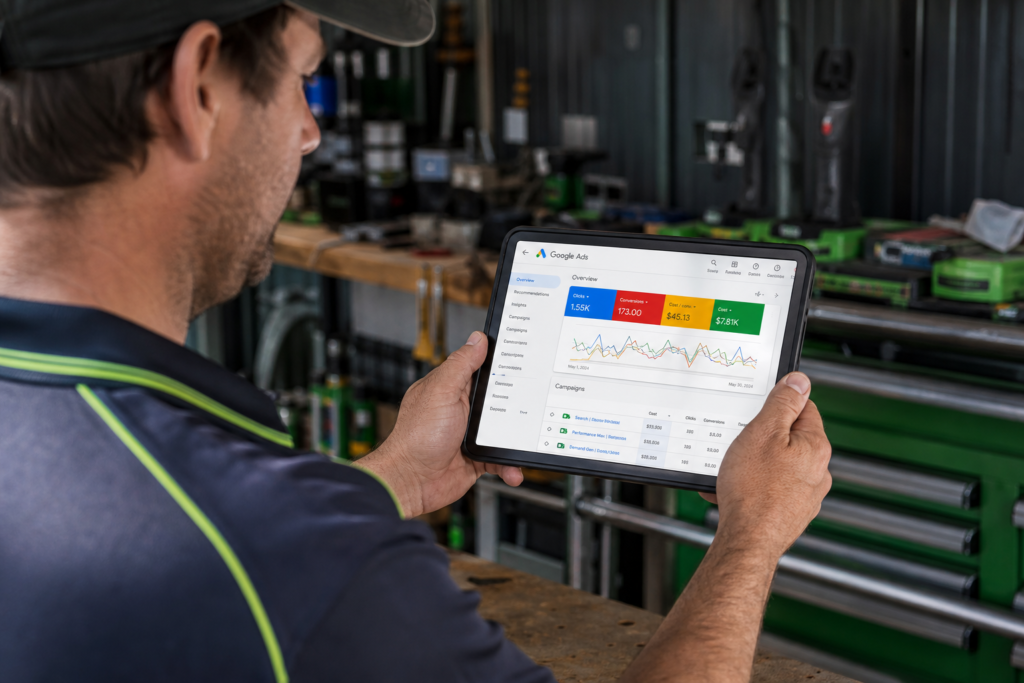
Google Ads puts your business in front of people who are actively searching for what you do. Not scrolling passively. Not watching content. Actively typing “emergency plumber Melbourne” or “solar installer Brisbane quote” into their phone.
That intent signal is what makes Google Ads different from most other paid platforms. You’re not interrupting someone’s day — you’re appearing exactly when they’ve decided they need you.
There are 2 main places you’ll appear:
Search Ads. Text ads that appear at the top of Google results pages. When someone searches for your service in your area, your ad appears above the organic results. You pay when someone clicks.
Google Maps (Local Pack). While this is primarily an organic and Google Business Profile play, ads can appear within the map pack. High visibility, strong conversion intent.
Most trade businesses running paid search are primarily using Search Ads — and that’s where most of the budget and most of the results come from.
What Does Google Ads Actually Cost for Tradies?
Honestly? It varies a lot. Anyone who quotes you a flat number without knowing your trade, your location, and your competition is guessing.
Here’s what actually drives the cost:
Cost per click (CPC) by trade. Emergency plumbing in a major metro area — you might be paying $8–$25 per click. Solar installation in a competitive market — $5–$15. Roofing, electrical, HVAC — similar ranges. Niche trades in less competitive regions can be $2–$6 per click. More competition for the same searches means higher CPCs.
Location. Sydney and Melbourne are more expensive than regional markets. More businesses bidding for the same searches means you pay more per click.
Seasonality. Demand for some trades spikes (air conditioning in summer, heating in winter). CPCs go up when demand goes up. Smart campaigns account for this.
Landing page quality. Google rewards ads that send traffic to relevant, fast-loading pages with good user experience. Better Quality Scores mean lower CPCs for the same position. A poorly built landing page doesn’t just convert badly — it costs you more per click.
Typical monthly ad spend for trade businesses: Most trade businesses running Google Ads meaningfully are spending $1,500–$8,000 per month in ad spend. Less than $1,000/month in a competitive trade and metro area often won’t generate enough volume to get useful data or consistent leads.
Management fees. If you’re working with an agency, you’ll pay management fees on top of ad spend. These range from $500–$2,000/month depending on the agency and scope. Be clear on the distinction: money going to Google (ad spend) versus money going to the agency (management). They’re different buckets.
When Google Ads Makes Sense for a Trade Business
Not every trade business is ready for Google Ads. That’s not a popular thing to say — but it’s true.
Here’s when it makes sense:
You have a sales process. When a lead comes in at 7pm on a Thursday, does someone contact them within five minutes? If not, that lead is going to the next person who answers. Speed to lead is everything in paid search. We’ve covered exactly why this matters.
You have capacity to deliver. If your team is already maxed out and you can’t take on more jobs, flooding the pipeline with leads creates chaos, not revenue. The first bottleneck for most trade businesses isn’t leads — it’s fulfilment.
You have a CRM to manage leads. Leads that land in your email inbox and sit there aren’t leads. They’re future regrets. A CRM like Tradie Hub means every lead is tracked, followed up, and doesn’t fall through the cracks.
Your average job value justifies the spend. If your average job is $400 and your cost per lead from ads is $120, the maths gets tight fast. If your average job is $4,000 and your cost per lead is $100–$200, Google Ads is one of the best investments you can make.
You have a website that converts. If your website is slow, hard to navigate on mobile, or doesn’t have a clear form or click-to-call button — you’re burning ad spend sending traffic to a page that doesn’t close the loop. Fix the site before you run the ads.
When Google Ads Won’t Work
This is the part most ad agencies don’t tell you, because it’s not in their interest to.
If you don’t have a follow-up system, ads will fracture your business. Running paid traffic to a business without a lead management process doesn’t generate more revenue — it generates more chaos. Leads come in faster than you can handle them, they die in your inbox, and you end up paying for enquiries that never turned into jobs.
We’ve seen it happen. A roofing business — same trade, same opportunity as another we were running for at the same time. Different results entirely:
Their way (no system):
– Leads: 22
– Won: 0
– Revenue: $0
– Return: 0%
Our way (managed system):
– Leads: 107
– Won: 9
– Revenue: $449,000
– Return: 9,937%
Same vertical. Same opportunity. Completely different outcome.
The difference wasn’t the ads. It wasn’t the budget. It was whether the business had a system to handle what the ads generated.
That’s why we won’t run ads for any business that doesn’t have our lead management system deployed first. That’s a line in the sand. Not because we’re precious about it — because we’ve seen what happens when you skip it.
If your margins are too thin for the CPCs in your market. Some trades in high-competition areas have Google CPCs that make the maths difficult unless you’re running volume or have a high average job value. Be honest about your numbers before committing to ad spend.
If you’re hoping ads will fix a broken business. Marketing won’t fix a slow business. If your quoting process takes three days, your follow-up is inconsistent, and your reviews are average — spending money on ads amplifies the problems, it doesn’t solve them.
Self-Managed vs Agency-Managed: The Honest Comparison
You can run Google Ads yourself. Google has made it increasingly accessible with smart campaigns and automated bidding.
But accessible and effective aren’t the same thing.
Self-managed trade business Google Ads tends to:
– Over-target broad keywords that burn budget on irrelevant clicks
– Miss negative keyword management (paying for clicks that will never convert)
– Have poor account structure that limits Quality Score improvement
– Lack conversion tracking that tells you which ads generate leads — not just clicks
– Get hammered when Google’s smart campaigns optimise for clicks rather than conversions
Agency-managed ads tend to:
– Have tighter targeting and keyword structure from day one
– Run ongoing negative keyword lists that reduce wasted spend
– Track actual conversions (form fills, calls) rather than vanity metrics
– Optimise based on what generates leads, not what looks good in a dashboard
If you want to understand the full checklist of what separates a well-run Google Ads account from a poorly run one, we’ve got a detailed Google Ads optimisation checklist for tradies that covers the key variables.
The management fee question is worth addressing directly. A good agency charges management fees because their expertise protects your ad spend from waste. If an agency reduces your cost per lead from $150 to $70, their management fee is paying for itself many times over. If they just set the campaign up and leave it running without optimisation, you’re paying for a subscription, not a service.
Ask the right questions before you sign.
What Results Can Tradies Realistically Expect?
Let’s be honest here — because a lot of agencies aren’t.
Results vary. They vary by trade, by market, by competition, by season, by website quality, by lead management process, by average job value, and by how much budget is behind the campaign.
Anyone who tells you exactly what results you’ll get before running your campaign is either lying or guessing. That’s not the honest way to frame it.
What we can tell you is what we’ve seen when the system is right.
That roofing business mentioned earlier — 9,937% return in one month. That’s not normal. That’s what happens when the ads are tight, the leads are handled fast, and the business closes well.
We’ve had solar businesses move from zero paid presence to generating $300,000+ in monthly revenue. We’ve had plumbers in competitive markets drop their cost per closed job to under $200.
But we’ve also seen ad campaigns that generated plenty of leads and zero revenue — because the business couldn’t close, couldn’t respond fast enough, or didn’t have the capacity to deliver.
The ROI from Google Ads for trade businesses is real. But it’s a function of the full system, not just the ad campaign.
The TWG Approach to Google Ads
We don’t sell ads. We sell more closed jobs. Ads are the medium — they’re not the offer.
The way we run Google Ads for trade businesses:
- The Impact Roadmap comes first. Before any ad spend, we understand the business — goals, capacity, current lead management, average job value, target revenue. Ads without that context are money burning.
- The system gets deployed before the traffic. CRM, automated follow-up, call tracking, and lead management processes are in place before we spend a dollar on clicks. We won’t run traffic to a leaky bucket.
- The campaign is built for conversions, not clicks. We track actual leads — form fills and phone calls — not vanity metrics. An ad campaign generating 300 clicks and zero calls has failed, regardless of what the click data shows.
- We optimise continuously. Search term analysis, negative keyword management, bid adjustments, Quality Score improvements. Ads get worse if you leave them alone. They get better when someone’s actively managing them.
- We report on what matters. Closed revenue, cost per lead, cost per closed job. Not impressions, not clicks — jobs and money.
If you want a deeper dive into how to actually read Google Ads data as a tradie, our guide to understanding Google Ads for tradies covers the reporting fundamentals worth knowing.
Google Ads for Specific Trades
Every trade has a different cost and competitive landscape. Here’s a rough benchmark by vertical for Australian markets:
Plumbing. Highly competitive in major metros. CPCs can run $10–$25 for emergency searches. Strong ROI when speed to lead is managed well. Getting more plumber leads from Google Ads is a known playbook — but execution is everything.
Electrical. Similar range to plumbing. Residential electricians tend to have lower CPCs than emergency or commercial. Good conversion rates when website trust signals are strong.
Solar. High average job values ($5,000–$20,000+) mean higher CPCs are still worthwhile. Very competitive in some markets. Lead quality is a key variable — solar leads often require nurturing before converting.
Roofing. Seasonal variation. Storm damage periods spike demand and CPCs. Good ROI when the follow-up process is fast and the quoting is prompt.
Builders and Renovators. Higher average job values, longer sales cycles. Google Ads works but needs to be part of a broader nurture system — the decision timeline is longer than most emergency trades.
HVAC, Landscaping, Irrigation. Strong seasonal patterns. CPC ranges vary widely by location and competition density.
The Question Isn’t “Can I Afford Google Ads?”
That’s the wrong frame entirely.
The right question is: “What does my revenue target require, and what do I need to spend to get there?”
Marketing spend is an allocation of revenue target, not a saving from what’s left in the account at the end of the month. If you need to generate $50,000 in new jobs per month to hit your targets, work backwards from cost per closed job to figure out the budget required.
A $3,000/month ad spend that generates $40,000 in closed revenue is a 1,233% return. That’s not an expense — that’s an investment with a clear return.
The businesses that treat marketing as a cost are the same ones that cut it the moment things get tight — and then wonder why things stay tight.
FAQs
Are Google Ads worth it for tradies in Australia?
Yes — when the business is set up to handle what they generate. Google Ads puts your business in front of people actively searching for your service. But ads alone don’t close jobs. You need a fast follow-up process, a converting website, and a CRM managing your leads. When those are in place, the ROI can be significant.
How much does Google Ads cost for a plumber or tradie in Australia?
Cost per click ranges from $5–$25+ depending on trade, location, and competition. Most trade businesses running Google Ads effectively spend $1,500–$8,000/month in ad spend. Management fees (if using an agency) are additional — typically $500–$2,000/month. The right number depends on your revenue targets and average job value, not a flat industry rate.
What’s the difference between Google Ads spend and management fees?
Ad spend goes directly to Google — it’s what pays for your clicks. Management fees go to the agency managing your account — that’s their fee for setting up, optimising, and reporting on your campaigns. Always get clarity on both numbers upfront.
How do I know if my Google Ads are actually working?
Track form fills and phone calls — not clicks or impressions. If your campaign generates 200 clicks and zero leads, it’s not working regardless of what the click-through rate says. Proper conversion tracking tells you which ads, keywords, and pages are generating actual enquiries. Without that, you’re flying blind.
Should I manage Google Ads myself or hire an agency?
Self-management is possible but rarely as effective. Poorly managed campaigns waste budget on irrelevant clicks, miss negative keyword opportunities, and optimise for the wrong signals. If your ad spend is above $2,000/month, a good agency should more than pay for their management fee through reduced waste and better conversion rates.
How quickly do Google Ads generate results for trade businesses?
Search Ads can generate leads within days of launching — it’s a near-instant visibility channel. However, the first few weeks often involve learning and optimisation as you gather real data on what converts. Most trade businesses see meaningful results within 4–8 weeks when the campaign is set up properly and the lead management system is in place.
What’s the most common reason Google Ads fail for tradies?
Not the ads — the follow-up. Leads arrive and die in an inbox because no one contacts them within the window when they’re still hot. If your response time is measured in hours or days rather than minutes, you’re converting a fraction of what you’re paying for. Speed to lead is the most common failure point we see.
Do I need a landing page or can I send ads to my homepage?
You should send paid traffic to a dedicated landing page that matches the specific search intent — not your homepage. Someone who searched “emergency plumber Sydney” should land on a page specifically about emergency plumbing in Sydney, with a prominent call button and short form. Generic homepage traffic converts poorly and wastes ad spend.
If you want to know whether Google Ads make sense for your business right now — and what your cost per closed job would realistically look like — book an Impact Roadmap Session. We’ll walk through your goals, your market, and your current setup, then tell you honestly whether ads are the right next step and what the system needs to look like to get the result.